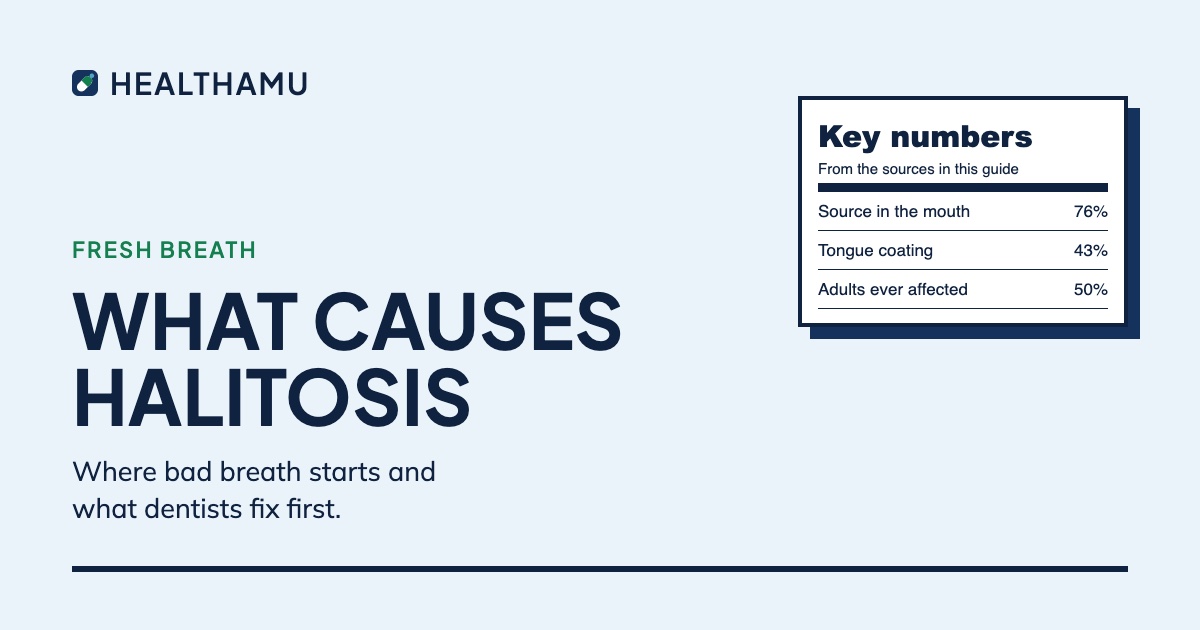
Halitosis is the medical term for bad breath that lasts. In a study of 2,000 clinic patients, 76% had a cause inside the mouth, mostly tongue coating and gum disease. Dry mouth, tonsil stones, sinus problems, reflux and diabetes explain some of the rest. The most useful steps are daily tongue cleaning, flossing, a dental cleaning and a check for medical causes if it persists.
On this page
- What is halitosis?
- What causes bad breath?
- How does tongue coating cause bad breath?
- Is gum disease behind your bad breath?
- Can dry mouth cause bad breath?
- Can tonsil stones cause bad breath?
- What medical conditions cause halitosis?
- How can you detect bad breath on yourself?
- What does the research say about bad breath treatments?
- Do probiotics like S. salivarius K12 help halitosis?
- Which bad breath fix fits your situation?
- What are the side effects of bad breath treatments, and when should you see a doctor?
- What is the best treatment for chronic halitosis?
- Bad breath checklist: what to do this week
- The bottom line on halitosis
- FAQ
Halitosis is the medical term for bad breath, and to explain it we read the MedlinePlus and ADA pages on bad breath, two NIDCR fact sheets, three Cochrane reviews, a study of 2,000 patients at a halitosis clinic and four reviews of rinses and probiotics. Our method is on the how we review health topics page.
In about 3 out of 4 people who seek help, the smell starts in the mouth, most often from the coating on the back of the tongue [7].
| What it is | Breath with an unpleasant smell that lasts or keeps coming back [1][5] |
|---|---|
| How common | About 31.8% of people in pooled studies; 50 percent of adults have had it at some point [6][2] |
| Main source | The mouth in 76% of clinic patients, led by tongue coating at 43% [7] |
| Other causes | Gum disease, dry mouth, tonsil stones, sinus problems, reflux, diabetes, liver or kidney disease [2][5] |
| First steps | Brush twice a day, clean between teeth daily, clean the tongue, drink water [2][3][5] |
| Best evidence | Low to very low certainty for every treatment tested; no single option shown to be best [9] |
| See a dentist | When bad breath stays after better brushing and flossing [2][5] |
What is halitosis?
Halitosis is the medical term for bad breath, a smell from the mouth or airway that other people can notice. Cleveland Clinic describes the odor as anything from sour to unpleasantly sweet, and breath tied to longer-term problems may smell like fish or rotten eggs [5]. A 2018 review of 13 studies put the pooled rate at 31.8% [6].
Short bouts are normal. Morning breath, a garlic lunch or a cup of coffee can all leave a smell for a few hours, and MedlinePlus lists raw onions, garlic and cabbage as common food triggers [1]. Doctors and dentists use the word halitosis mostly for breath that stays bad day after day.
The ADA says 50 percent of adults have had bad breath at some point in their lives [2]. People who visited one specialist halitosis clinic had put up with it for an average of 7 years before they came in [7].
What causes bad breath?
Most bad breath comes from bacteria in the mouth that break down food bits and leave a foul-smelling waste product. The ADA and MedlinePlus both name poor brushing and flossing as the most common reason, followed by gum disease, dry mouth, cavities, food and tobacco [1][2].
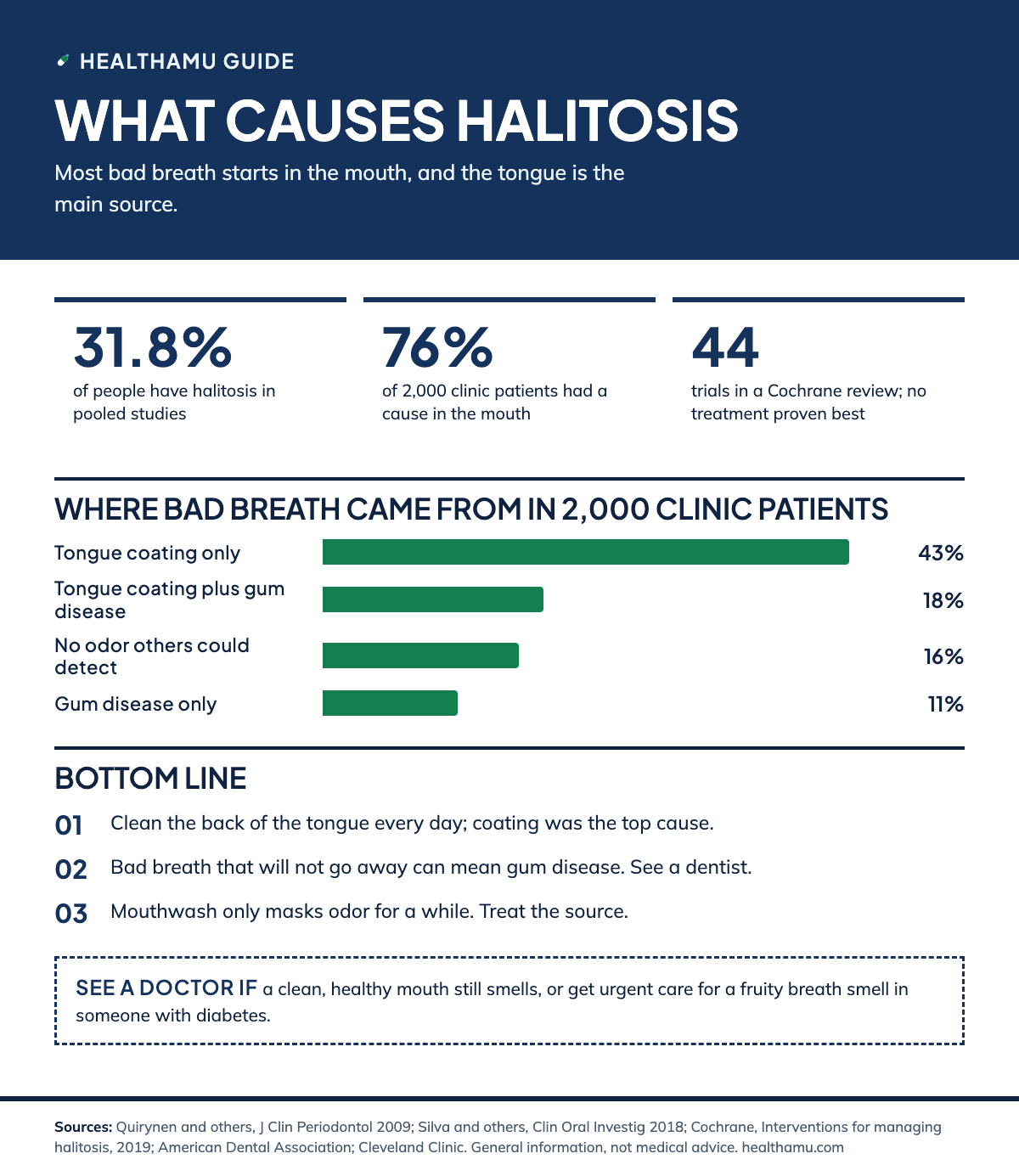
The clearest numbers come from a study of 2,000 patients at a halitosis clinic [7]:
- 76% had a cause inside the mouth.
- 43% had tongue coating alone.
- 11% had gum inflammation or gum disease alone.
- 18% had both tongue coating and gum disease.
- 16% had no real odor that others could detect. Doctors call this pseudo-halitosis or halitophobia.
The rest came from the nose, throat or the body as a whole [7]. Smoking adds its own smell, dries the mouth and raises the risk of gum problems [1][5]. Sinus problems can also drip foul fluid into the back of the throat [1][5].
How does tongue coating cause bad breath?
Tongue coating is a film of bacteria, dead cells and food debris on the back of the tongue, and it was the single biggest cause in the halitosis clinic study. It explained 43% of cases on its own and was part of another 18% [7]. The rough surface of the tongue gives bacteria many places to hide.
Cleveland Clinic says scraping the tongue is especially important because bacteria and food debris collect there [5]. The ADA also tells people to clean the tongue as part of daily care [2].
The research on tongue cleaning is thin. An older Cochrane review found 2 trials with 40 people. In one, sulfur gas levels fell 42% with a tongue cleaner, 40% with a tongue scraper and 33% with a toothbrush, and the drop could not be measured more than 30 minutes later [10]. That review was later withdrawn and folded into a 2019 Cochrane review. The newer review rated tongue cleaning as very low certainty evidence, based on 2 trials and 46 people [9]. Scraping is cheap and low risk, and Cleveland Clinic and the ADA still advise tongue cleaning [2][5].
Is gum disease behind your bad breath?
Gum disease is a common cause of bad breath that will not go away, and people with periodontitis had 3.16 times the odds of halitosis in a pooled review. That review combined 5 cross-sectional studies, so it shows a link and cannot prove cause [8].
NIDCR lists bad breath that does not go away as a symptom of gum disease, along with red, swollen or bleeding gums and teeth that feel loose [4]. The ADA adds that a constant bad taste in the mouth can be a warning sign of advanced gum disease [2].
Plaque can harden into tartar, which can lead to gum disease if it is not removed [4]. Cleveland Clinic says plaque-related bad breath usually responds to a dental cleaning plus better home care [5], while the ADA calls mouthwash only a temporary solution [2]. If your gums are also pulling back from your teeth, our guide on how to fix receding gums walks through the steps dentists use in order.
Can dry mouth cause bad breath?
Yes. Saliva rinses food and bacteria from the mouth all day, so when it runs low, odor builds up fast. NIDCR lists bad breath as one of the symptoms of dry mouth [3].
NIDCR says hundreds of medicines can reduce saliva, including some for high blood pressure, depression and bladder control [3]. Diabetes, Sjogren’s disease, HIV, radiation to the head and neck, and some cancer drugs can also dry the mouth [3]. The ADA adds salivary gland problems and breathing through the mouth [2].
NIDCR is clear that dry mouth is not a normal part of aging [3]. Its tips include drinking 8 to 12 cups of water a day, chewing sugarless gum and avoiding tobacco and alcohol [3]. The ADA suggests chewy foods like carrots or apples to get saliva moving, and says a dentist may recommend artificial saliva [2].
Can tonsil stones cause bad breath?
Tonsil stones can cause bad breath because trapped food in the tonsils can harden into bad-smelling calcium deposits at the back of the throat. Cleveland Clinic lists them among the causes of halitosis [5]. They sit out of reach of a toothbrush, so breath can stay bad even with good brushing.
Infections in the nose and throat can do something similar. They can leave foul-smelling fluid in the back of the throat, and pneumonia can make a person cough up fluid that smells bad [5]. MedlinePlus names sinusitis and nose problems as possible causes too [1].
We found no good data on how often tonsil stones are the main cause, so we do not guess at a number. If you see white or yellow lumps on your tonsils, or the smell seems to come from your throat, a dentist or an ear, nose and throat doctor can check.
What medical conditions cause halitosis?
When a dentist has ruled out mouth causes, the ADA says bad breath may point to a sinus condition, gastric reflux, diabetes, or liver or kidney disease. In that case the next step is your regular doctor [2]. MedlinePlus notes that some diseases and medicines cause a specific breath odor [1].
Cleveland Clinic gives more detail on several of these [5]:
- Diabetes. It raises the risk of gum disease. Very low insulin can lead to ketoacidosis, an emergency that can make breath smell fruity.
- Reflux (GERD). Stomach acid can come back up into the throat and mouth and taste sour.
- Head and neck cancers. Cancers of the mouth, throat and voice box can all cause bad breath.
- Kidney or liver disease. These organs may not filter waste from the body as they should, and the effects can show up on the breath.
These causes are much less common than tongue and gum problems. In the clinic study, only a small share of patients had a cause outside the mouth [7].
How can you detect bad breath on yourself?
The most reliable home check is to ask someone you trust, because cupping a hand over your mouth and sniffing does not work well. Cleveland Clinic gives this advice, and also suggests paying attention to a bad taste in the mouth [5]. A bad taste that does not go away is a warning sign the ADA links to advanced gum disease [2].
In research and at a dental visit, there are two standard checks. In the organoleptic test, a trained examiner smells the breath and scores it. The other method uses a meter to measure the sulfur gases that cause most mouth odor [9][15].
Some people are sure they have bad breath when nobody else can smell it. In the clinic study this was 16% of patients [7]. If several trusted people say your breath is fine, tell your dentist about the worry anyway. The clinic study authors say these patients need care from more than one kind of specialist [7].
What does the research say about bad breath treatments?
Every halitosis treatment tested so far rests on low to very low certainty evidence, and no option has been shown to beat the others. That is the main finding of the 2019 Cochrane review of 44 trials and 1,809 people [9]. Most trials followed people for only one to four weeks [9].
| Review | What it covered | Main result | Limits |
|---|---|---|---|
| Cochrane, 2019 [9] | 44 trials, 1,809 people, all treatment types | No treatment shown better than another | Low to very low certainty |
| Cochrane, 2006 [10] | Tongue scraping, 2 trials, 40 people | Scrapers cut sulfur gases more than a toothbrush | Effect gone within 30 minutes in one trial; later withdrawn |
| Cochrane, 2008 [11] | Mouthrinses, 5 trials, 293 people | Chlorhexidine, cetylpyridinium and zinc rinse lowered odor scores | More tongue and tooth staining; later withdrawn |
| Slot and others, 2015 [12] | 12 trials of 2 weeks or longer | Best data for rinses with chlorhexidine, cetylpyridinium and zinc | Effect of most products unclear |
| Huang and others, 2022 [15] | Probiotics, 7 trials | Lower odor scores in 4 weeks or less | Limited data, mixed trial designs |
Across these reviews, rinses with antibacterial ingredients can lower odor for a while, and tongue cleaning helps in the short term [11][12]. For lasting results, people still need to remove plaque and tongue coating every day and get gum disease treated [2][4].
Do probiotics like S. salivarius K12 help halitosis?
The evidence for probiotics in halitosis is Limited: a few small trials show short-term drops in odor scores, and the K12 strain did no better than placebo in its own trial. We use Limited to mean some trials exist, but they are small or low quality [13][14][15].
Streptococcus salivarius K12 is a strain that lives in the mouth and is sold as a lozenge. In a 2020 trial, 28 adults with tongue-coating halitosis sucked a K12 or placebo tablet daily for 30 days. Scores fell from where they started, but the K12 group did not differ from the placebo group [14]. The authors said the tongue coating probably has to be removed first [14].
Pooled reviews are a little more hopeful. A 2019 analysis of 3 trials found lower odor scores with probiotics but no change in sulfur gases [13]. A 2022 review of 7 trials found short-term benefit in 4 weeks or less and warned that limited data and mixed designs weaken the result [15]. A probiotic may help some people a little, for a while. It does not replace brushing, flossing, tongue cleaning or dental care.
Which bad breath fix fits your situation?
Match the first step to the most likely source of the smell, and give each change time; most product trials ran at least two weeks [12]. The table below uses the causes and advice from MedlinePlus, the ADA, NIDCR and Cleveland Clinic [1][2][3][5].
| What you notice | Likely source | First step |
|---|---|---|
| White or yellow film on the back of the tongue | Tongue coating [7] | Clean the tongue daily with a scraper or brush [5] |
| Bleeding gums, bad taste, loose teeth | Gum disease [4] | Book a dental exam and cleaning [4] |
| Sticky, dry mouth, worse in the morning or on new medicine | Dry mouth [3] | Sip water, chew sugarless gum, ask about your medicines [3] |
| Smell seems to come from the throat, small lumps on tonsils | Tonsil stones or throat infection [5] | See a dentist or doctor to check the throat [5] |
| Stuffy nose, postnasal drip | Sinus problem [1] | See your doctor about the sinus problem [2] |
| Sour taste, heartburn | Reflux [5] | See your doctor about reflux [2] |
| Fruity smell in someone with diabetes | Possible ketoacidosis [5] | Get urgent care right away [5] |
| Good oral care, but bad breath persists | Medical cause not yet found [2] | Ask your doctor to look beyond the mouth [2] |
What are the side effects of bad breath treatments, and when should you see a doctor?
Most bad breath care is low risk, but strong antibacterial rinses can stain teeth and the tongue. In the Cochrane mouthrinse review, a rinse with chlorhexidine, cetylpyridinium chloride and zinc caused much more tongue and tooth staining than placebo [11]. Cleveland Clinic suggests an alcohol-free antibacterial mouthwash, and notes that some products only mask odor [5].
Tongue scrapers were well accepted in the Cochrane trials. In one of them, using a toothbrush on the tongue caused nausea in 60% of people [10]. Probiotics are usually mild for healthy adults, but NCCIH reports severe or fatal infections in premature infants given probiotics [16]. People with a weak immune system or a serious illness should ask a doctor before trying one.
See a doctor right away if bad breath comes with any of these [5]:
- A fruity breath smell in someone with diabetes, which can signal ketoacidosis, a medical emergency.
- A cough that brings up foul-smelling fluid, which can happen with pneumonia.
- Foul-smelling fluid from the nose or the back of the throat, which can come from an infection.
- A mouth or throat problem that keeps getting worse, since cancers of the mouth, throat and voice box can cause bad breath.
Book a dental visit if bad breath does not get better after you improve your brushing, flossing and tongue cleaning [2][5].
What is the best treatment for chronic halitosis?
The best treatment for chronic halitosis is to find and treat the cause, which for most people means a dental exam, a professional cleaning and better daily care. Cleveland Clinic says plaque-related bad breath usually improves with a dental cleaning and good home care [5]. MedlinePlus says that when a disease is behind the smell, treating it may help [1].
A typical path looks like this:
- A dentist checks the teeth, gums and tongue, and looks for cavities and gum pockets [2][4].
- Plaque and tartar are removed with a cleaning; deeper gum disease may need more treatment [4].
- You start daily tongue cleaning and cleaning between the teeth [2][5].
- The dentist may suggest a special antibacterial rinse for a set time [5][11].
- If dry mouth is part of it, your medicines are reviewed and saliva aids are tried [3].
- If the mouth looks healthy, your doctor checks the sinuses, throat, stomach and blood sugar [2].
Over-the-counter mouthwash is a short-term helper. The ADA calls it only a temporary solution [2]. Supplements, including probiotics, are an optional extra with Limited evidence and never stand in for this care [9][15].
Bad breath checklist: what to do this week
A short daily routine handles most bad breath, and a dentist visit covers the rest. These steps come from the ADA, NIDCR and Cleveland Clinic [2][3][5]. For more on breath and gum care, browse our fresh breath guides or the wider dental health section.
- Brush twice a day and clean between your teeth once a day [2].
- Clean the back of your tongue every day [5].
- Clean retainers and dentures as your dentist directs [5].
- Drink water through the day; NIDCR suggests 8 to 12 cups if your mouth is dry [3].
- Chew sugar-free gum or eat crunchy foods to get saliva flowing [2][3].
- Cut back on tobacco and alcohol, which dry the mouth [3][5].
- Pick an alcohol-free antibacterial mouthwash if you use one [5].
- Read the label on any probiotic lozenge and check our review standards for what to look for [16].
- Book a dental cleaning if your breath stays bad after these changes [2][5].
The bottom line on halitosis
Halitosis almost always starts in the mouth, mainly from tongue coating and gum disease [7]. Dry mouth, tonsil stones and a handful of medical conditions explain much of the rest [2][3][5].
For most people, a dental cleaning plus daily tongue cleaning is the better first step than any rinse or lozenge, because it deals with the source of the smell. The research on every treatment is weak, so a dentist’s exam to find your cause matters more than which product you buy [9].
Frequently asked questions
Does mouthwash cure bad breath?
No. The ADA calls over-the-counter mouthwash only a temporary solution, and Cleveland Clinic notes some products only mask odor. Antibacterial rinses can lower odor for a while, but the lasting fix is removing plaque and tongue coating and treating gum disease.
Is tongue scraping better than brushing the tongue?
In small Cochrane trials, scrapers and tongue cleaners lowered sulfur gases a bit more than a toothbrush, and one trial found brushing the tongue caused nausea in many people. The evidence is weak, but scraping is cheap and low risk.
Can you have halitosis and not know it?
Yes. Smelling your own breath is hard, so Cleveland Clinic suggests asking someone you trust. A bad taste that does not go away is another clue, and the ADA links it to advanced gum disease.
Can bad breath be a sign of diabetes?
It can be. Diabetes raises the risk of gum disease, which causes bad breath. In someone with diabetes, a fruity breath smell can signal ketoacidosis, a medical emergency caused by very low insulin that needs care right away.
Is bad breath ever all in your head?
Sometimes. In a study of 2,000 halitosis clinic patients, 16% had no odor others could detect. Doctors call this pseudo-halitosis or halitophobia, and it still deserves care from a dentist and sometimes other specialists.
Sources
- Bad Breath. MedlinePlus, National Library of Medicine
- Bad Breath: 6 Causes (and 6 Solutions). American Dental Association, MouthHealthy
- Dry Mouth. National Institute of Dental and Craniofacial Research
- Periodontal (Gum) Disease. National Institute of Dental and Craniofacial Research
- Bad Breath (Halitosis). Cleveland Clinic, 2025
- Estimated prevalence of halitosis: a systematic review and meta-regression analysis. Silva and others, Clinical Oral Investigations, 2018
- Characteristics of 2000 patients who visited a halitosis clinic. Quirynen and others, Journal of Clinical Periodontology, 2009
- Is periodontitis associated with halitosis? A systematic review and meta-regression analysis. Silva and others, Journal of Clinical Periodontology, 2017
- Interventions for managing halitosis. Kumbargere Nagraj and others, Cochrane Database of Systematic Reviews, 2019
- Tongue scraping for treating halitosis. Outhouse and others, Cochrane Database of Systematic Reviews, 2006 (withdrawn 2016)
- Mouthrinses for the treatment of halitosis. Fedorowicz and others, Cochrane Database of Systematic Reviews, 2008 (withdrawn 2016)
- Treatment of oral malodour: medium-term efficacy of mechanical and/or chemical agents. Slot and others, Journal of Clinical Periodontology, 2015
- The Effect of Probiotics on Halitosis: a Systematic Review and Meta-analysis. Yoo and others, Probiotics and Antimicrobial Proteins, 2019
- The Effect of Streptococcus salivarius K12 on Halitosis: a Double-Blind, Randomized, Placebo-Controlled Trial. He and others, Probiotics and Antimicrobial Proteins, 2020
- Efficacy of probiotics in the management of halitosis: a systematic review and meta-analysis. Huang and others, BMJ Open, 2022
- Probiotics: What You Need To Know. National Center for Complementary and Integrative Health

Lucie Bricks is the Reviews Editor at Healthamu, a buyer's guide for supplements sold through online ads. Lucie reads the full label, sets each dose beside the doses used in human studies, grades the research with sources such as the NIH Office of Dietary Supplements and NCCIH, and works out the real cost per day, refund terms and checkout fine print. Lucie is not a doctor, dietitian, nurse or pharmacist. Reviews give pros, cons and who a product suits, never scores. How we review supplements.
This article is general information, not medical advice. Dietary supplements are not reviewed by the FDA for safety or effectiveness before they are sold. Talk to your doctor before you start any supplement, especially if you are pregnant, nursing, take medication or have a health condition.