To lower LDL, cut saturated fat, eat about 3 g of oat or barley fiber a day, add plant sterols at two meals, and lose 3% to 5% of body weight if you are overweight. Sleep 7 to 9 hours and stay active. If LDL stays high, or you have heart disease or diabetes, a statin is the standard first medicine. Skip red yeast rice.
On this page
- How to lower LDL: 8 steps in the order that works
- What is LDL, and what level is too high?
- What foods lower LDL cholesterol?
- How to lower LDL cholesterol naturally: how far can diet go?
- Does red yeast rice lower LDL, and is it safe?
- When do doctors start a statin for high LDL?
- Who should be careful, and when should you see a doctor?
- Your LDL action checklist
- Bottom line on how to lower LDL
- FAQ
How to lower LDL comes down to a handful of tested steps. To check them, we read the NHLBI treatment and TLC pages, two MedlinePlus pages, the 2018 AHA/ACC cholesterol guideline, two FDA health claim rules, the NCCIH page on red yeast rice and four trials or meta-analyses. Our review process explains how we pick and check sources.
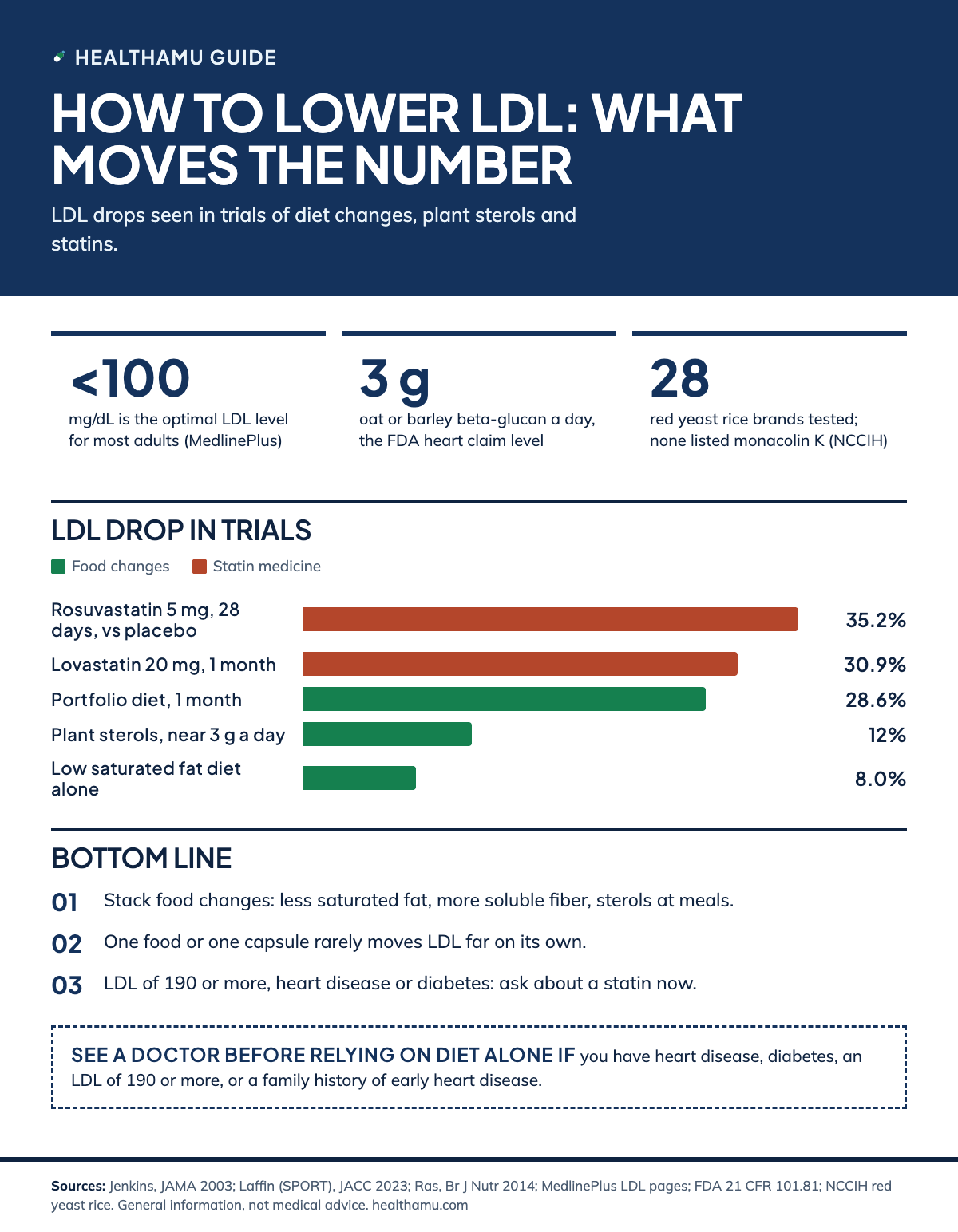
The short answer: cut saturated fat, add soluble fiber and plant sterols, lose a little weight if you carry extra, and ask about a statin if your LDL stays high. In one trial, a combined food plan cut LDL by 28.6% in a month, close to the 30.9% seen with a low-dose statin[10].
| What LDL is | The “bad” cholesterol that builds up as plaque in artery walls[2] |
|---|---|
| Optimal level | Under 100 mg/dL for most adults; 70 or lower if you have heart disease or high risk[2][3] |
| First step for everyone | A heart-healthy lifestyle, per the 2018 AHA/ACC guideline[4] |
| Daily food amounts | 3 g oat or barley beta-glucan, or 7 g psyllium fiber; 1.3 g plant sterol esters[7][8] |
| Most used medicine | Statins, which reduce the cholesterol your liver makes[1] |
| Best evidence | A 124-study meta-analysis of plant sterols and a JAMA diet vs statin trial[9][10] |
| Avoid | Red yeast rice with real monacolin K: it acts like a statin drug with no dose on the label[11] |
How to lower LDL: 8 steps in the order that works
Lowering LDL means two things: fewer foods that raise it, and more foods and habits that block or clear it, with medicine added when risk is high. NHLBI lists food, activity, weight, sleep, stress and smoking as the levers you control[1]. These steps start with the largest food change and end with the medical check.
- Get a lipid panel and learn your number. A blood test shows your LDL, HDL, non-HDL and triglycerides. You may need to fast for 9 to 12 hours before it[3]. Write the LDL number down so you can compare later.
- Cut saturated fat first. MedlinePlus calls saturated fat “the main problem” for blood cholesterol[3]. Swap fatty cuts of meat, full-fat dairy and baked desserts for fish, skinless poultry, beans and low-fat dairy[1][5].
- Add soluble fiber every day. FDA ties 3 g a day of beta-glucan from whole oats or barley, or 7 g a day of psyllium fiber, to lower heart disease risk[7]. Oatmeal, barley, beans and fruit are easy sources[5].
- Eat plant sterols or stanols with meals. FDA uses 1.3 g of sterol esters or 3.4 g of stanol esters a day, split over two meals[8]. Look for fortified spreads, milks or juices.
- Build meals around nuts, beans and whole grains. NHLBI’s TLC and DASH plans favor whole grains, fruit, vegetables and a variety of nuts over sweets and refined carbs[1].
- Lose a small amount of weight if you are overweight. Losing only 3% to 5% of body weight can lower LDL[1]. MedlinePlus suggests at least 5%, which is 10 pounds for a 200-pound person[3].
- Move, sleep and stop smoking. Regular activity can lower LDL and triglycerides, and 7 to 9 hours of sleep a day lowers the risk of high LDL[1]. Quitting smoking and limiting alcohol help your heart as well[1].
- Recheck and talk about medicine. If lifestyle changes alone do not bring LDL down enough, you may need medicine[2]. After a statin is started or changed, the guideline calls for a repeat test in 4 to 12 weeks[4].
What is LDL, and what level is too high?
LDL (low-density lipoprotein) is the cholesterol carrier that leaves cholesterol in artery walls, where it forms plaque. That plaque narrows arteries and can cause chest pain or a heart attack[2]. For LDL, lower numbers are better. A reading of 160 mg/dL or more counts as high[2].
| LDL level (mg/dL) | Category |
|---|---|
| Under 100 | Optimal[2] |
| 100 to 129 | Near optimal or above optimal[2] |
| 130 to 159 | Borderline high[2] |
| 160 to 189 | High[2] |
| 190 and above | Very high[2] |
Your own goal can be lower. MedlinePlus lists 70 mg/dL or below for people at high risk or with heart disease, and 55 or below for those at very high risk[3].
Some things raise LDL that diet cannot fix. These include genes, such as familial hypercholesterolemia, and some steroids, blood pressure medicines and HIV medicines[2]. Kidney disease and diabetes can raise it too[2].
Women should know that LDL tends to rise after menopause[2]. Women aged 55 to 65 and men aged 45 to 65 should be tested every 1 to 2 years. Younger adults need a test every 5 years, and people over 65 need one each year[3].
What foods lower LDL cholesterol?
The foods that lower LDL most reliably are those rich in soluble fiber or plant sterols, eaten in place of foods high in saturated fat. Soluble fiber and sterols both block cholesterol from being absorbed in the gut[5]. The amounts below come from FDA health claim rules and pooled trials.
| Food or nutrient | Daily amount | What the evidence shows |
|---|---|---|
| Oat or barley beta-glucan | 3 g or more | FDA heart health claim level[7] |
| Psyllium husk fiber | 7 g or more | FDA heart health claim level[7] |
| Plant sterol esters | 1.3 g or more, over 2 meals | FDA claim level[8] |
| Plant stanol esters | 3.4 g or more, over 2 meals | FDA claim level[8] |
| Plant sterols and stanols (free) | 0.6 to 3.3 g | LDL down 6% to 12% on average[9] |
| Nuts, beans, whole grains | Daily, in place of refined carbs | Part of NHLBI’s TLC and DASH plans[1] |
Fiber on its own does less than people expect. A meta-analysis of 67 trials found that each gram of soluble fiber lowered LDL by about 0.057 mmol/L[6]. Three bowls of oatmeal give about 3 g and lower LDL by roughly 0.13 mmol/L, or about 5 mg/dL[6]. The authors called this “only a small contribution” on its own[6].
Saturated fat and cholesterol in food push LDL up[2]. The big sources are fatty meats, full-fat dairy and desserts[1]. The TLC plan also caps sodium at 2,300 mg a day for heart health[5].
How to lower LDL cholesterol naturally: how far can diet go?
Diet alone can lower LDL by a little or by a lot, depending on how many tools you stack together. A diet low in saturated fat cut LDL 8.0% in one month. Adding sterols, soy, sticky fiber and almonds took the drop to 28.6%[10]. That combined plan is often called the portfolio diet.
| Study | Who and how long | What was tested | LDL result |
|---|---|---|---|
| Jenkins, JAMA 2003 | 46 adults with high cholesterol, 1 month | Low saturated fat diet vs same diet plus lovastatin 20 mg vs portfolio diet | Down 8.0%, 30.9% and 28.6%[10] |
| Ras, Br J Nutr 2014 | 124 studies pooled | Plant sterols or stanols, 0.6 to 3.3 g a day | Down 6% to 12%, leveling off near 3 g[9] |
| Brown, Am J Clin Nutr 1999 | 67 controlled trials | Soluble fiber, 2 to 10 g a day | Down about 0.057 mmol/L per gram[6] |
| Laffin (SPORT), JACC 2023 | 190 adults at raised risk, 28 days | Rosuvastatin 5 mg vs placebo vs 6 supplements | Statin 35.2% lower than placebo; no supplement beat placebo[12] |
The portfolio trial was small and short, and people in it ate a tightly planned diet[10]. The sterol review was written by authors linked to a sterol spread maker, and doses above 4 g a day were too few to pool[9].
In the SPORT trial, plant sterol and red yeast rice capsules did no better than placebo over 28 days, while a low-dose statin did[12]. AstraZeneca, which makes rosuvastatin, paid for that trial[12]. Food changes add up when you stack them, while a single food or capsule rarely moves LDL far.
Does red yeast rice lower LDL, and is it safe?
Red yeast rice can lower LDL only when it contains monacolin K, which is the same molecule as the statin drug lovastatin. NCCIH says products with considerable monacolin K are treated by FDA as unapproved new drugs and are not sold legally in the United States[11]. Products sold legally may have little or none.
The label will not tell you which kind you have. A 2017 review of 28 US brands found none listed monacolin K. Two had none, and the rest ranged from 0.09 to 5.48 mg per 1,200 mg[11].
Products that do contain it can cause the same side effects as statins, including muscle, kidney and liver damage[11]. They also carry the same drug interactions[11]. Some contain citrinin, a toxin that can harm the kidneys. In a 2021 test of 37 products, only one was below the EU citrinin limit, and four labeled “citrinin-free” were contaminated[11].
NCCIH does not recommend red yeast rice during pregnancy or breastfeeding[11]. If your LDL is high enough that you want a statin effect, a prescribed statin gives you a known dose and medical follow-up.
When do doctors start a statin for high LDL?
Statins are the first-line medicine for high LDL, and the 2018 AHA/ACC guideline uses your LDL level, age and risk to decide when to start one. Statins cut the cholesterol your liver makes and lower the risk of heart attack and stroke in people with high LDL[1].
The guideline sets a few clear triggers[4]:
- People who already have heart or artery disease get a high-intensity or maximally tolerated statin, aiming to cut LDL by 50% or more[4].
- An LDL of 190 mg/dL or higher means starting a high-intensity statin without running a risk score[4].
- Adults 40 to 75 with diabetes and an LDL of 70 or higher start a moderate-intensity statin[4].
- Other adults 40 to 75 have a risk talk with their clinician first. If a statin is chosen, the target is a 30% drop, or 50% when 10-year risk is 20% or higher[4].
MedlinePlus adds that you may need a statin if you are 30 or older with an LDL of 160 or more[3]. If a statin is not enough or causes side effects, doctors may add or switch to ezetimibe, bempedoic acid, bile acid sequestrants or an injected PCSK9 inhibitor[1].
Keep the food changes going once you start medicine. NHLBI says the two work together[1].
Who should be careful, and when should you see a doctor?
Anyone with an LDL of 190 or more, known heart disease, diabetes or a family history of early heart disease should see a doctor before relying on diet alone. These groups often need medicine in addition to lifestyle changes[4]. Inherited high cholesterol may also need special care[1].
Keep these safety points in mind:
- Never stop a prescribed statin because you changed your diet. Talk to your doctor and recheck your levels first[2].
- Statins rarely damage the liver, but they can raise diabetes risk, mainly in people who already have prediabetes or obesity[1].
- Bile acid sequestrants can cause diarrhea and make some other medicines work less well[1].
- Red yeast rice can interact with medicines the way statins do[11].
- Ask your doctor before starting a new exercise plan[1].
Get emergency care right away for chest pain, chest pressure or other signs of a heart attack. Blocked blood flow to the heart is what high LDL can lead to[2].
Your LDL action checklist
Use this list to turn the steps into a weekly routine you can check off. Each item comes from NHLBI, MedlinePlus or an FDA claim rule[1][3][7][8]. Read food labels for fiber and sterol grams, and see our how we review page for how we judge product claims.
- Book a lipid panel and write down your LDL, HDL and non-HDL numbers[3].
- Swap one high saturated fat food a day for beans, fish or skinless poultry[1].
- Eat oats or barley daily to reach about 3 g of beta-glucan[7].
- Check labels on fortified spreads or drinks for 0.65 g of sterol esters per serving, and use them at two meals[8].
- Keep sodium under 2,300 mg a day[5].
- Aim for 7 to 9 hours of sleep and regular activity[1].
- Skip red yeast rice; its monacolin K dose is unknown[11].
- Recheck LDL with your doctor and ask whether a statin fits your risk[4].
More guides on cholesterol and the heart sit in our cholesterol and heart health section.
Bottom line on how to lower LDL
LDL drops when you stack changes: less saturated fat, more soluble fiber, plant sterols with meals and a little weight loss. In a month-long trial, that mix lowered LDL almost as much as a starter statin[10]. No capsule in the SPORT trial matched a low-dose statin[12].
For most people the food changes are the right first step, because they carry little risk and the effects add up. If your LDL is 190 or higher, or you have heart disease or diabetes, start the statin talk now rather than waiting to see what diet can do[4].
Frequently asked questions
How to lower LDL cholesterol in 30 days?
Combine several food changes at once. In a one-month trial, a diet low in saturated fat with plant sterols, soy protein, sticky fiber and almonds cut LDL by 28.6%, while the low saturated fat diet alone cut it by 8.0%.
What is a low cholesterol diet?
It limits saturated fat and dietary cholesterol and adds soluble fiber and plant sterols. NHLBI's TLC and DASH plans favor fruit, vegetables, whole grains, beans, nuts, fish and low-fat dairy, with sodium kept under 2,300 mg a day.
Is an LDL of 130 high?
An LDL of 130 to 159 mg/dL is borderline high for adults. Under 100 is optimal. If you have heart disease or high risk, your doctor may set a goal of 70 or lower, so ask what target fits you.
Does exercise lower LDL cholesterol?
NHLBI says regular physical activity can lower LDL and triglycerides and raise HDL. Activity also helps with weight, and losing 3% to 5% of body weight can lower LDL. Ask your doctor what level of activity is safe for you.
How often should you check your LDL?
Adults 21 to 65 usually need a test every 5 years. Men 45 to 65 and women 55 to 65 should test every 1 to 2 years, and adults over 65 each year. After starting a statin, a recheck in 4 to 12 weeks is standard.
Sources
- Blood Cholesterol: Treatment. NHLBI, NIH, 2024
- LDL: The "Bad" Cholesterol. MedlinePlus, National Library of Medicine
- Cholesterol Levels: What You Need to Know. MedlinePlus, National Library of Medicine
- 2018 AHA/ACC Guideline on the Management of Blood Cholesterol (Grundy et al.). Circulation, 2019 (published online 2018)
- TLC: Therapeutic Lifestyle Changes to Lower Cholesterol. NHLBI, NIH
- Cholesterol-lowering effects of dietary fiber: a meta-analysis (Brown et al.). American Journal of Clinical Nutrition, 1999
- 21 CFR 101.81: Health claims, soluble fiber from certain foods and coronary heart disease. FDA regulation, eCFR
- 21 CFR 101.83: Health claims, plant sterol/stanol esters and coronary heart disease. FDA regulation, eCFR
- LDL-cholesterol-lowering effect of plant sterols and stanols across different dose ranges (Ras et al.). British Journal of Nutrition, 2014
- Effects of a dietary portfolio of cholesterol-lowering foods vs lovastatin (Jenkins et al.). JAMA, 2003
- Red Yeast Rice: What You Need To Know. NCCIH, NIH
- Rosuvastatin vs placebo and 6 common supplements: the SPORT trial (Laffin et al.). Journal of the American College of Cardiology, 2023

Lucie Bricks is the Reviews Editor at Healthamu, a buyer's guide for supplements sold through online ads. Lucie reads the full label, sets each dose beside the doses used in human studies, grades the research with sources such as the NIH Office of Dietary Supplements and NCCIH, and works out the real cost per day, refund terms and checkout fine print. Lucie is not a doctor, dietitian, nurse or pharmacist. Reviews give pros, cons and who a product suits, never scores. How we review supplements.
This article is general information, not medical advice. Dietary supplements are not reviewed by the FDA for safety or effectiveness before they are sold. Talk to your doctor before you start any supplement, especially if you are pregnant, nursing, take medication or have a health condition.