Beta-sitosterol and pygeum have the best evidence among prostate supplements, with modest gains in urinary symptoms and flow in small, short trials of 519 and 1,562 men. Saw palmetto showed little to no benefit across 27 studies. Vitamin E raised prostate cancer risk by 17% in a large trial. Lifestyle changes and prescribed medicines still come first for BPH.
On this page
- What are the best prostate supplements?
- 1. Beta-sitosterol: the best pick for weak flow and night trips?
- 2. Pygeum: a fit for men who mainly wake up at night to pee?
- 3. Pumpkin seed: worth a try if you want a food-based option?
- 4. Stinging nettle root: a low-risk option with thin proof?
- 5. Saw palmetto: why is the most popular one graded Weak?
- 6. Vitamin E: why should men avoid it for prostate health?
- Which prostate supplements are not worth your money?
- Do prostate pills help with bladder and urinary support?
- What is the best prostate medicine on the market?
- Who should not take prostate supplements?
- How do you choose a prostate health supplement?
- Bottom line
- FAQ
To rank prostate supplements, we read the NCCIH saw palmetto page, the NIDDK and MedlinePlus pages on enlarged prostate, the National Cancer Institute summary on prostate supplements, four Cochrane reviews and three large trials[1][2][3][4]. We graded each ingredient type, not brands, using the method on our how we review supplements page.
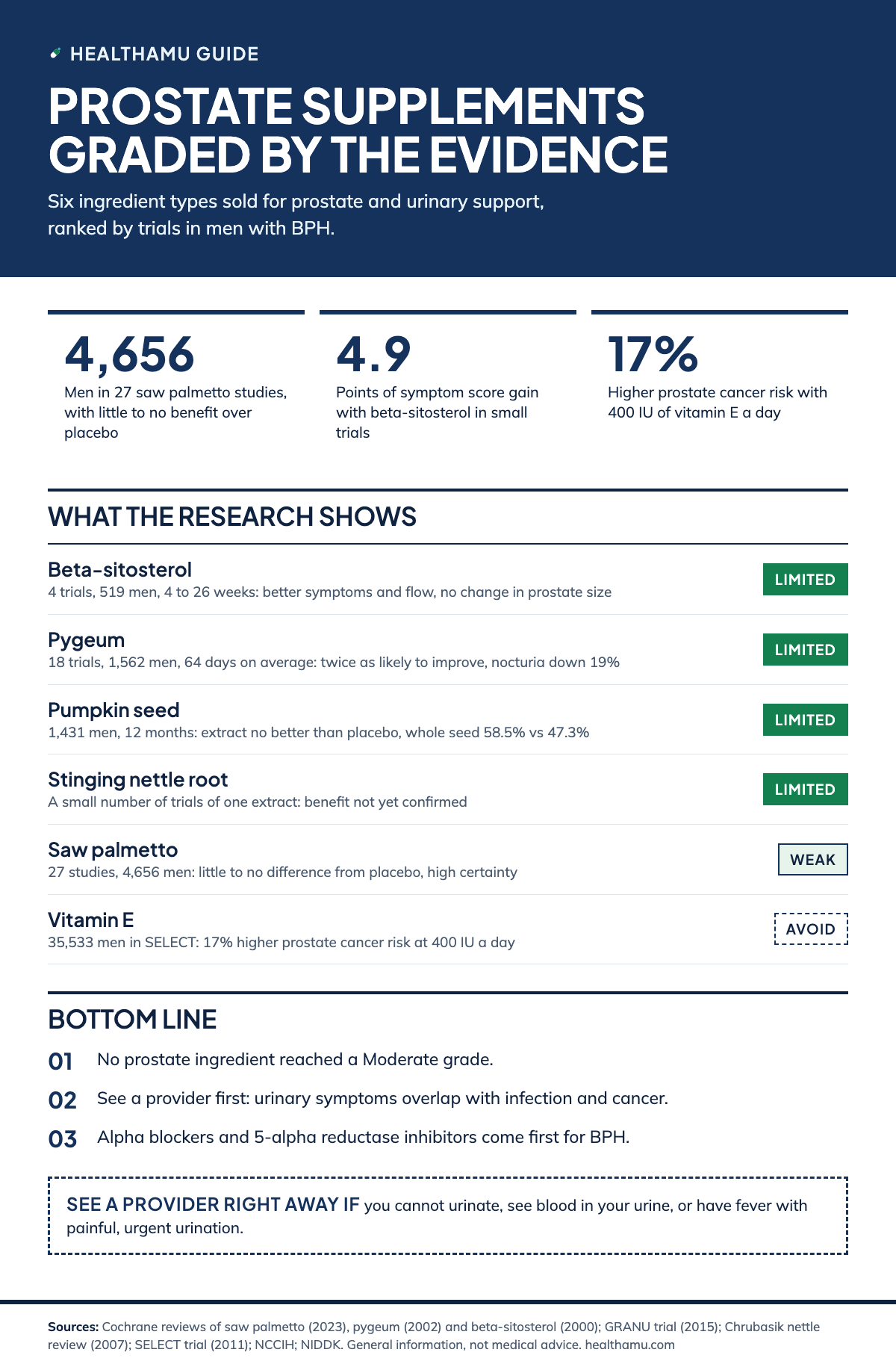
The short answer: no prostate supplement earns better than a Limited grade, and the best-selling one, saw palmetto, showed little to no benefit across 27 studies of 4,656 men[5]. Beta-sitosterol and pygeum have the most encouraging data, from small, short trials[7][6].
| What this ranks | Ingredient types sold for prostate and urinary support, graded by trials in men with an enlarged prostate (BPH)[2] |
|---|---|
| Most promising | Beta-sitosterol (4 trials, 519 men) and pygeum (18 trials, 1,562 men), both graded Limited[7][6] |
| Most popular, weakest result | Saw palmetto: little to no difference from placebo in a 2023 Cochrane review[5] |
| One to avoid | Vitamin E at 400 IU a day raised prostate cancer risk by 17% in a trial of 35,533 men[11][4] |
| How common BPH is | 5% to 6% of men aged 40 to 64 and 29% to 33% of men 65 and older[2] |
| Who should ask first | Men on prostate or blood pressure medicine, and anyone with new urinary symptoms[2][1] |
| What doctors use first | Lifestyle changes, then alpha blockers and 5-alpha reductase inhibitors[2] |
What are the best prostate supplements?
On current evidence, the best prostate supplements are beta-sitosterol and pygeum, and both carry only a Limited grade. Each improved urinary symptoms or flow against placebo in pooled trials, but the trials were few, small and short[7][6]. None of them shrank the prostate, and none was tested head to head with standard drugs[7][6].
These products are sold for BPH, which means the prostate has grown larger but is not cancer[3]. BPH is the most common prostate problem in men over 50[2]. It does not raise your risk of prostate cancer[3].
We used four grades, and each one describes the strength of the research behind an ingredient.
| Grade | What it means |
|---|---|
| Moderate | Several pooled trials, with a small but consistent effect |
| Limited | Some trials, but small, short, low quality or mixed |
| Weak | Pilot studies only, or reviews and large trials found no benefit |
| Avoid | No evidence of benefit plus a safety problem |
No prostate ingredient reached Moderate. Here is what the main reviews and trials found.
| Ingredient and study | Men | Length | What happened |
|---|---|---|---|
| Beta-sitosterol, Cochrane 2000[7] | 519 in 4 trials | 4 to 26 weeks | Symptom score 4.9 points better than placebo; no change in prostate size |
| Pygeum, Cochrane 2002[6] | 1,562 in 18 trials | 64 days on average | Twice as likely to report improvement; nocturia down 19% |
| Pumpkin seed, GRANU 2015[9] | 1,431 | 12 months | Extract no better than placebo; whole seed 58.5% vs 47.3% responders |
| Stinging nettle root, 2007 review[8] | A small number of trials | Varied | Possible benefit from one extract, not yet confirmed |
| Saw palmetto, Cochrane 2023[5] | 4,656 in 27 studies | 3 to 17 months | Little to no difference from placebo, high certainty |
| Lycopene, Cochrane 2011[10] | 154 in 3 trials | Varied | No difference in PSA; too little data on symptoms |
| Vitamin E, SELECT 2011[11] | 35,533 | Planned 7 to 12 years[4] | 17% higher prostate cancer risk at 400 IU a day |
1. Beta-sitosterol: the best pick for weak flow and night trips?
Beta-sitosterol is a plant sterol, and in a Cochrane review it gave the largest symptom gain of any prostate ingredient we graded. Across 4 trials with 519 men, it lowered the International Prostate Symptom Score by 4.9 points more than placebo, in the 2 trials that used that score[7]. Grade: Limited.
Peak urine flow rose by 3.91 mL a second, and the amount of urine left in the bladder fell[7]. Men quit at about the same rate as on placebo, 7.8% against 8.0%[7].
The trials lasted only 4 to 26 weeks, and the reviewers said long-term benefit is unknown[7]. Beta-sitosterol also did not reduce prostate size[7]. The FDA has not approved it as a treatment for any medical condition[4].
2. Pygeum: a fit for men who mainly wake up at night to pee?
Pygeum is an extract from the bark of the African plum tree, and it has the most trials of the herbs that showed some benefit. In 18 trials with 1,562 men, those on pygeum were more than twice as likely to report better symptoms than men on placebo[6]. Grade: Limited.
Nighttime urination fell by 19%, leftover urine fell by 24%, and peak flow rose by 23%[6]. Side effects were mild and similar to placebo[6].
The trials averaged just 64 days, and only one reported how the groups were concealed[6]. They also never compared pygeum with alpha blockers or 5-alpha reductase inhibitors[6]. The reviewers said bigger, longer trials are still needed[6].
3. Pumpkin seed: worth a try if you want a food-based option?
Pumpkin seed gave mixed results in the largest trial of it, and the capsule extract did no better than placebo. The German GRANU trial followed 1,431 men aged 50 to 80 for 12 months[9]. Grade: Limited.
Men took 5 g of whole pumpkin seed twice a day, 500 mg of pumpkin seed extract twice a day, or a placebo[9]. The extract group did not differ from placebo[9]. In the whole-seed group, 58.5% of men responded against 47.3% on placebo, a difference the authors called descriptive only[9].
Both products were well tolerated[9]. The authors said a confirmatory study is needed before anyone recommends pumpkin seed for urinary symptoms[9].
4. Stinging nettle root: a low-risk option with thin proof?
Stinging nettle root has a very low risk of side effects, but its benefit for prostate symptoms is still unconfirmed. A 2007 review found that most of the evidence came from open studies without a placebo group[8]. Grade: Limited.
A small number of randomized trials suggested that one specific extract eased symptoms[8]. The reviewers wrote that the size of the effect “remains to be established” before nettle root could join treatment guidelines[8].
If you try it, note that the trials used a particular extract. A nettle leaf tea or an unnamed root powder is not the same product.
5. Saw palmetto: why is the most popular one graded Weak?
Saw palmetto is the best-known prostate herb, and the best evidence shows it works about as well as a placebo. The 2023 Cochrane review pooled 27 studies with 4,656 men and found little to no difference in urinary symptoms, with high certainty[5]. Grade: Weak.
In the short term, symptom scores improved by just 0.90 points on a 35-point scale[5]. NCCIH concludes that saw palmetto is “probably not helpful” for BPH symptoms[1]. Two NIH-funded trials, one at up to three times the usual dose, showed no improvement[1].
It is well tolerated, and it has been used safely in studies for up to 3 years, and side effects such as stomach upset, dizziness and headache are mild and infrequent[1]. It does not change PSA readings[1].
6. Vitamin E: why should men avoid it for prostate health?
Vitamin E supplements should be avoided for prostate health, because the largest trial found they raised prostate cancer risk. SELECT gave 35,533 healthy men 400 IU of vitamin E a day, selenium, both, or placebo[11]. Grade: Avoid.
By the final analysis, 620 men in the vitamin E group had prostate cancer, against 529 on placebo[11]. That is a 17% higher risk[4][11]. The trial authors concluded that vitamin E “significantly increased the risk of prostate cancer among healthy men”[11].
Many multi-ingredient prostate formulas include vitamin E. Check the label before you buy, and skip products that add it at high doses.
Which prostate supplements are not worth your money?
Lycopene, zinc and selenium are common in prostate formulas, yet none has shown a benefit for prostate symptoms in controlled trials. Each earns a Weak grade from us.
Lycopene
A Cochrane review found only 3 trials with 154 men[10]. Lycopene did not change PSA, and 2 of the 3 trials had a high risk of bias[10]. The reviewers found no robust trial evidence on prostate symptoms[10].
Zinc
We found no controlled trial of zinc for BPH symptoms. Too much zinc carries real risks. The adult upper limit is 40 mg a day, and long-term excess can lower HDL cholesterol and weaken immune function[12]. Zinc also interacts with quinolone and tetracycline antibiotics[12].
Selenium
In SELECT, 200 mcg of selenium a day had no significant effect on prostate cancer risk[11]. Based on the early results, the trial’s safety committee told the men to stop taking the study supplements[4].
Do prostate pills help with bladder and urinary support?
Prostate pills sold for bladder or urinary support have small and uncertain effects at best, and the symptoms they target can have many causes. Trouble starting a stream, a weak stream, dribbling and getting up at night can come from BPH, but also from bladder problems, urinary tract infections, prostatitis or prostate cancer[2].
So a label promise of “urinary support” says little about your own cause. Some common medicines can also make urinary symptoms worse, including cold medicines with decongestants or antihistamines, some antidepressants and diuretics[2]. Ask your provider about those first.
The ingredients with the best data, beta-sitosterol and pygeum, improved flow and night urination modestly in short trials[7][6].
What is the best prostate medicine on the market?
For BPH, doctors usually start with lifestyle changes and then prescribe alpha blockers or 5-alpha reductase inhibitors, which have far stronger evidence than any supplement. NIDDK lists these as the main medicines[2]. A supplement is not a replacement for them.
Alpha blockers relax the muscles at the bladder neck and in the prostate, which makes urinating easier[2]. 5-alpha reductase inhibitors help stop prostate growth or shrink it[2]. Phosphodiesterase-5 inhibitors are another option, and combining an alpha blocker with a 5-alpha reductase inhibitor may work better than either alone[2].
Lifestyle steps come first for mild symptoms. They include cutting back on fluids before bed, limiting caffeine and alcohol, and reviewing medicines that make symptoms worse[2]. For men who do not improve, there are minimally invasive procedures and surgery[2].
Who should not take prostate supplements?
Anyone with new or worsening urinary symptoms should see a provider before trying a supplement, because the same symptoms can signal infection or cancer. A supplement can delay a diagnosis if you use it in place of a checkup[2].
Other cautions from the sources we read:
- Saw palmetto may be unsafe during pregnancy or breastfeeding[1].
- Men who take antibiotics should ask before taking zinc, since it interacts with quinolones and tetracyclines[12].
- Skip vitamin E supplements sold for the prostate, given the SELECT result[11].
- Herbal products can vary a lot from lot to lot, and the label may not match what is inside[4].
- Tell your provider about any supplement if you already take BPH medicine, so your symptoms can be judged fairly[1].
See a provider right away if you:
- cannot urinate at all[2]
- have painful, frequent and urgent urination with fever and chills[2]
- see blood in your urine[2]
- have great discomfort or pain in your lower belly or urinary tract[2]
How do you choose a prostate health supplement?
Start with a checkup, then, if you still want a supplement, pick one well-studied ingredient and judge it after a fair trial. The trials that showed benefit ran from about 4 weeks to 6 months[7][6]. Use the table below to match your situation with a sensible next step.
| Your situation | Reasonable next step | Why |
|---|---|---|
| New urinary symptoms, no diagnosis yet | See a provider before any supplement | Symptoms overlap with infection and cancer[2] |
| Diagnosed mild BPH, want to try a supplement | Beta-sitosterol or pygeum | Best trial results, though short and small[7][6] |
| Already on saw palmetto with no change | Stop it and talk to your provider | High-certainty review found little to no benefit[5] |
| Prefer a food-based approach | Whole pumpkin seed | Mixed but well tolerated in a 12-month trial[9] |
| Formula lists vitamin E | Choose a product without it | Raised prostate cancer risk in SELECT[11] |
| Bothersome symptoms despite lifestyle changes | Ask about alpha blockers or 5-ARIs | Standard first-line medicines[2] |
Before you buy, run through these label checks:
- Choose a single-ingredient product so you can tell whether it helps.
- Look for the named extract, since the trials tested specific extracts and herbal products vary from lot to lot[8][4].
- Skip formulas that add vitamin E or more than 40 mg of zinc a day[11][12].
- Ignore claims that a product shrinks the prostate. Beta-sitosterol, the best-tested ingredient, did not[7].
- Remember that supplements are not approved by the FDA before they are sold[1].
- Read how we grade products on our supplement review methods page, browse our prostate health guides, and see the rest of our best supplement rankings.
Bottom line
For most men with urinary symptoms, the better first step is a checkup and, if it is BPH, lifestyle changes or a prescribed medicine, because those have strong evidence and no supplement comes close[2]. If you still want to try one, beta-sitosterol or pygeum has the best support, and the benefit in trials was modest and short term[7][6].
Skip saw palmetto if it has not helped you, since the strongest review found little to no benefit[5]. Avoid vitamin E sold for the prostate[11]. Give any supplement a few months at most, tell your provider, and stop it if nothing changes.
Frequently asked questions
Do prostate supplements lower PSA?
The ones we checked did not. Saw palmetto does not affect PSA readings, even at higher than usual amounts, and lycopene showed no PSA difference in a Cochrane review. A normal PSA on a supplement means the same as without one, so keep your scheduled tests.
Can a supplement shrink an enlarged prostate?
No supplement we graded has shown that. Beta-sitosterol, the best-tested ingredient, improved symptoms and flow but did not reduce prostate size. Prescription 5-alpha reductase inhibitors are the medicines that help stop prostate growth or shrink it.
Is it safe to take prostate supplements with BPH medication?
The sources we read did not document clear interactions for beta-sitosterol, pygeum or saw palmetto. Still, tell your provider before you add one. Taking both can make it harder to judge whether your prescribed medicine is working, and products vary from lot to lot.
How long should you try a prostate supplement?
The trials that found a benefit ran from about 4 weeks to 6 months, and the pygeum trials averaged 64 days. If your symptoms have not changed after a trial of that length, it is reasonable to stop and talk to your provider.
Is saw palmetto safe even if it does not work?
For most men it appears safe. NCCIH says it is well tolerated and has been used safely in studies for up to 3 years, with mild, infrequent side effects such as stomach upset, dizziness and headache. It may be unsafe in pregnancy or breastfeeding.
Sources
- Saw Palmetto: Usefulness and Safety. NCCIH, National Institutes of Health, 2025
- Enlarged Prostate (Benign Prostatic Hyperplasia). NIDDK, National Institutes of Health, 2024
- Enlarged Prostate (BPH). MedlinePlus, National Library of Medicine
- Prostate Cancer, Nutrition, and Dietary Supplements (PDQ). National Cancer Institute
- Serenoa repens for the treatment of lower urinary tract symptoms due to benign prostatic enlargement. Cochrane Database of Systematic Reviews, 2023
- Pygeum africanum for benign prostatic hyperplasia. Cochrane Database of Systematic Reviews, 2002
- Beta-sitosterols for benign prostatic hyperplasia. Cochrane Database of Systematic Reviews, 2000
- A review on the stinging nettle effect and efficacy profiles. Part II: urticae radix. Phytomedicine, 2007
- Effects of pumpkin seed in men with lower urinary tract symptoms due to BPH in the one-year GRANU study. Urologia Internationalis, 2015
- Lycopene for the prevention of prostate cancer. Cochrane Database of Systematic Reviews, 2011
- Vitamin E and the risk of prostate cancer: the Selenium and Vitamin E Cancer Prevention Trial (SELECT). JAMA, 2011
- Zinc: Fact Sheet for Health Professionals. NIH Office of Dietary Supplements

Lucie Bricks is the Reviews Editor at Healthamu, a buyer's guide for supplements sold through online ads. Lucie reads the full label, sets each dose beside the doses used in human studies, grades the research with sources such as the NIH Office of Dietary Supplements and NCCIH, and works out the real cost per day, refund terms and checkout fine print. Lucie is not a doctor, dietitian, nurse or pharmacist. Reviews give pros, cons and who a product suits, never scores. How we review supplements.
This article is general information, not medical advice. Dietary supplements are not reviewed by the FDA for safety or effectiveness before they are sold. Talk to your doctor before you start any supplement, especially if you are pregnant, nursing, take medication or have a health condition.