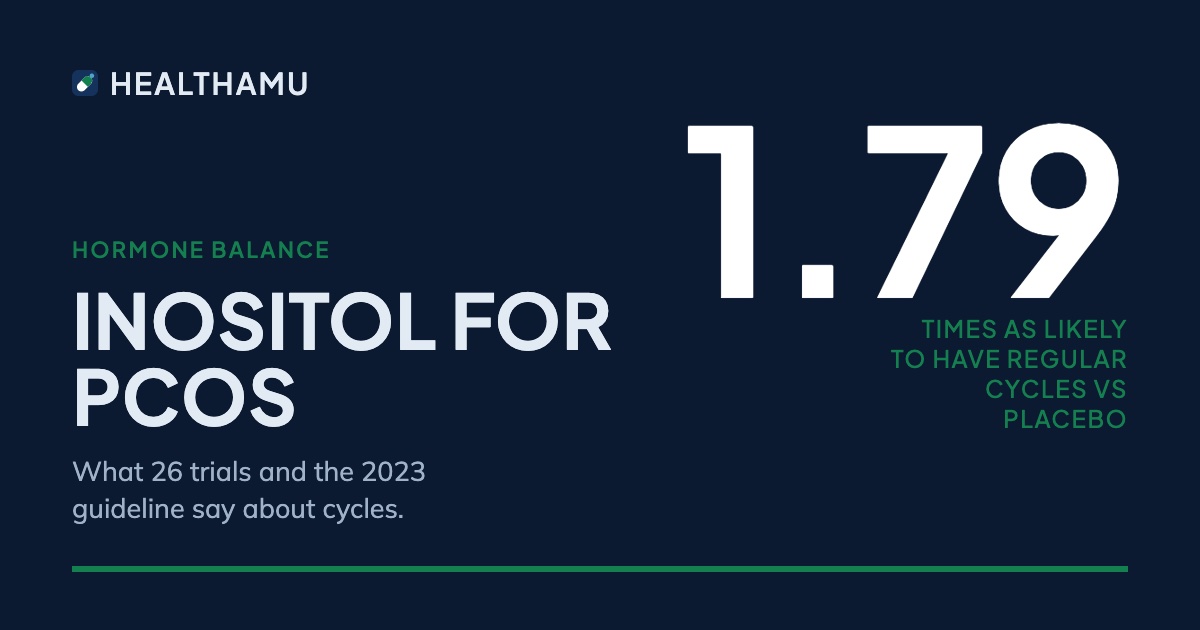
Inositol for PCOS has some trial support. In a review of 26 trials, people taking it were 1.79 times as likely as those on placebo to have regular cycles, and insulin resistance dropped a little. The 2023 international guideline still rates the evidence very low, backs no specific dose or form, and prefers metformin for hair growth and waist size.
On this page
- What is inositol for PCOS, and how is it supposed to work?
- Myo-inositol vs D-chiro-inositol: which form was studied?
- What do trials show for menstrual cycles and ovulation?
- Does myo-inositol help insulin resistance in PCOS?
- Inositol vs metformin for PCOS: how do they compare?
- What dose of myo-inositol was used in PCOS trials?
- Does inositol help fertility or IVF in PCOS?
- What are the side effects of inositol, and who should avoid it?
- What is the treatment for PCOS that doctors use first?
- A simple decision table: is inositol worth discussing?
- Practical checklist before you try inositol
- Bottom line on inositol for PCOS
- FAQ
Inositol for PCOS is one of the most searched supplement questions in women’s health, so we went to the source papers. We read the 2023 International PCOS Guideline, the meta-analysis written to inform it, the 2018 Cochrane review on fertility, three newer reviews and the NIH pages on PCOS care. You can see how we choose and grade sources on our how we review page.
The short answer: pooled trials link inositol with more regular cycles and small drops in insulin resistance, but the 2023 guideline rates that evidence as very low certainty and says no specific dose or form can be recommended.[4][1]
| What it is | A sugar-like compound the body makes and uses in insulin signaling. Supplements sell two forms: myo-inositol (MI) and D-chiro-inositol (DCI).[2] |
|---|---|
| Studied for | Insulin resistance, irregular cycles, ovulation, androgen levels and IVF outcomes in PCOS.[2][3] |
| Amounts used in trials | Myo-inositol 1 to 4 g a day, often with 200 to 400 mcg folic acid. D-chiro-inositol 600 to 1,200 mg a day.[2] |
| Best evidence | A 2024 review of 30 trials (2,230 people) called the evidence limited and inconclusive.[2] |
| Safety | Mild stomach upset in some people; fewer stomach side effects than metformin.[2][7] |
| Official position | Could be considered based on personal preference; experimental as a fertility therapy.[1] |
| Talk to a doctor first if | You are pregnant, trying to conceive, or already take metformin or fertility drugs.[1][10] |
What is inositol for PCOS, and how is it supposed to work?
Inositol is a compound that helps carry the insulin signal inside cells, and PCOS often comes with insulin resistance. The idea behind taking it is simple. If cells respond better to insulin, the body may make less insulin, and high insulin can push the ovaries to make more androgens.[2]
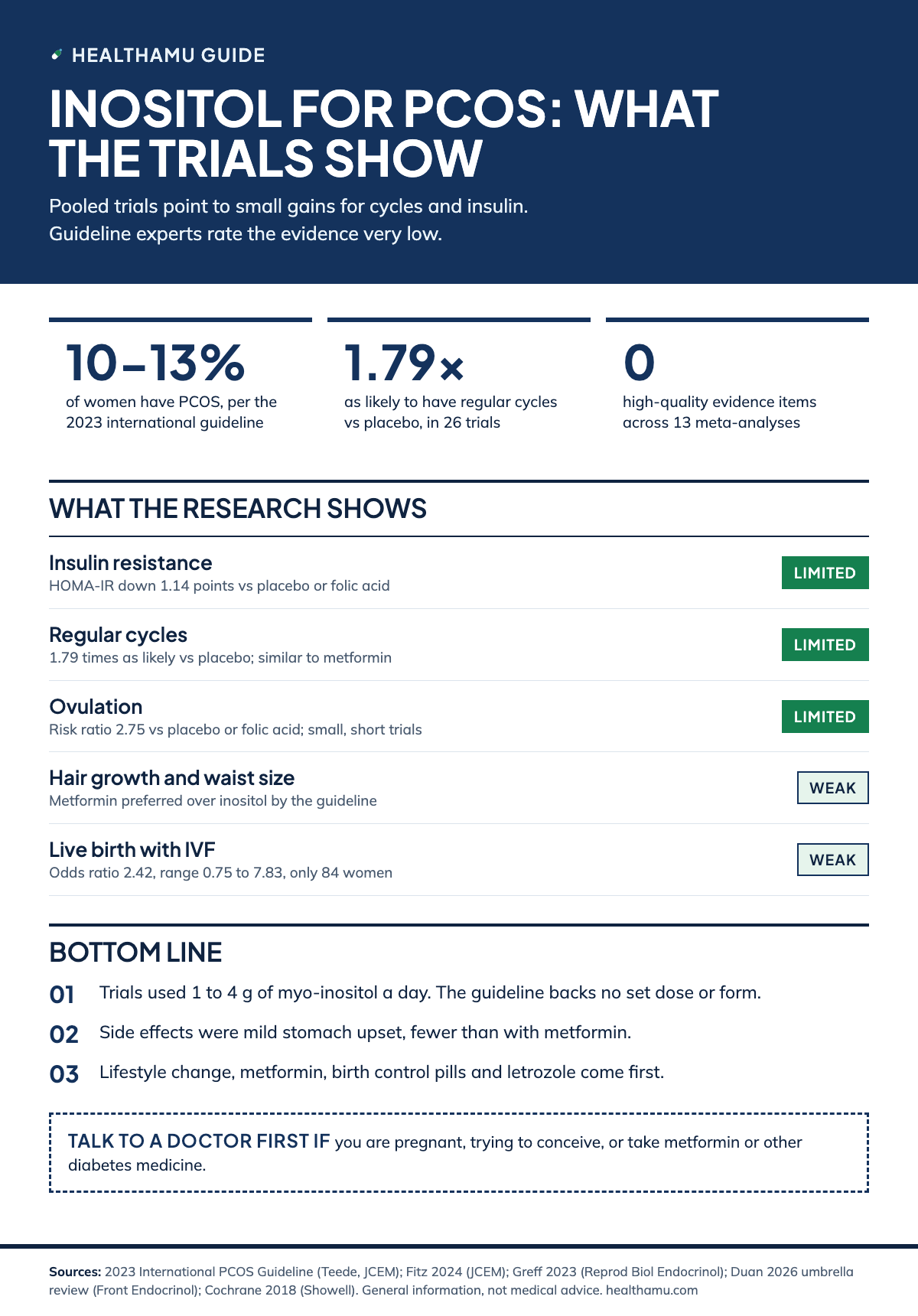
PCOS is common. The 2023 guideline puts it at 10% to 13% of women.[1] NIH describes it as a set of symptoms tied to a hormone imbalance, with most people having at least two of three features: missed or irregular ovulation, high androgens or their signs, and many small follicles on the ovaries.[8]
NICHD now notes that PCOS is also known as Polyendocrine Metabolic Ovary Syndrome, or PMOS. The new name points to the metabolic side of the condition, which is the part inositol was studied for.[8]
Inside the body, insulin drives the conversion of myo-inositol into D-chiro-inositol. Researchers think this balance may be off in PCOS, which is why both forms show up in trials and on supplement labels.[2] The theory has lab support. The trials below test whether it holds up in people.
Myo-inositol vs D-chiro-inositol: which form was studied?
Myo-inositol is the form tested most often in PCOS trials, at 1 to 4 g a day. In the 2024 review for the guideline, 20 studies tested myo-inositol alone or with folic acid, two tested D-chiro-inositol alone, and others tested blends of the two.[2]
D-chiro-inositol trials used 600 to 1,200 mg a day.[2] That review found possible benefits from D-chiro-inositol for ovulation, but the trials were small, with 20 and 44 people.[2]
A 2026 umbrella review of 13 meta-analyses found that myo-inositol, with or without folic acid, looked better for metabolic and reproductive results. It said D-chiro-inositol taken alone “should be used with caution” and that blends did not reliably beat single forms.[5]
You will see a 40:1 myo-to-D-chiro ratio on many labels. The guideline review says this ratio “has been suggested” as natural for the body, and the support comes mainly from mouse studies.[2] The guideline itself says no specific type, dose or combination can be recommended yet.[1]
What do trials show for menstrual cycles and ovulation?
In a 2023 meta-analysis of 26 trials and 1,691 patients, people taking inositol were 1.79 times as likely as those on placebo to have a regular cycle. The same review found inositol about as good as metformin for cycle regularity.[4]
The 2026 umbrella review pooled earlier meta-analyses and reported a higher ovulation rate with inositol than with placebo or folic acid alone (risk ratio 2.75).[5] It also found that none of its 85 evidence items reached high quality. Only 18.9% were moderate, and the rest were low or very low.[5]
The guideline group read much of the same research and came out more cautious. It lists “limited clinical benefits including in ovulation, hirsutism, or weight” and rates its certainty as very low.[1]
The two views differ because the pooled reviews count many small, short trials, often 3 to 6 months long, with mixed doses and outcomes.[2][5] The guideline weighs how much those flaws could bias the result. So cycles may improve for some people, though nobody can yet say by how much.
Does myo-inositol help insulin resistance in PCOS?
Trials suggest myo-inositol can lower insulin resistance a little, and this metabolic effect is the best supported finding. The 2024 guideline review found benefits from myo-inositol or D-chiro-inositol “for some metabolic measures.”[2]
The 2026 umbrella review reported an average HOMA-IR drop of 1.14 points versus placebo or folic acid. HOMA-IR is a score built from fasting glucose and insulin.[5] The 2023 meta-analysis also found lower glucose and lower insulin after a sugar drink in the inositol groups.[4]
These are lab measures. A lower insulin score is a reasonable target in PCOS, but the trials did not run long enough to show fewer cases of type 2 diabetes or heart disease. The guideline describes the benefit as a “potential for improvement in metabolic measures.”[1]
The weight data look weaker. The 2024 review found the evidence on body mass index very uncertain, and the guideline lists weight among the areas with limited benefit.[2][1] If weight or waist size is your main goal, inositol is unlikely to move it much on its own.
Inositol vs metformin for PCOS: how do they compare?
Metformin did better than inositol for excess hair growth and waist-to-hip ratio, while inositol caused fewer stomach side effects. For reproductive outcomes, the 2024 guideline review found likely no difference between the two.[2]
Based on that review, the guideline says metformin “should be considered over inositol for hirsutism and central adiposity,” while noting that metformin brings more stomach side effects.[1] The 2026 umbrella review agreed that inositol did not beat metformin on most measures.[5]
Some people take both. A 2025 review of 6 trials and 388 patients found that adding inositol to metformin made regular cycles more likely than metformin alone (risk ratio 1.56). It did not improve body mass index, fasting glucose or HOMA-IR.[6]
| Question | Inositol | Metformin |
|---|---|---|
| Status | Dietary supplement | Prescription drug, not FDA approved for PCOS[12] |
| Hirsutism and waist size | Smaller effect | Preferred by the guideline[1] |
| Cycle regularity | Similar to metformin in one review[4] | May help restart ovulation after a few months[12] |
| Stomach side effects | Fewer, usually mild[2] | More common[1] |
What dose of myo-inositol was used in PCOS trials?
Most pooled PCOS trials gave 2 to 4 g of myo-inositol a day, usually with 200 to 400 mcg of folic acid. Across the 2024 guideline review, doses ranged from 1 to 4 g daily, and 6 of the 8 pooled trials in one comparison used 4 g a day.[2]
The guideline does not set a dose. It says specific “types, doses, or combinations of inositol cannot currently be recommended” because good evidence is missing.[1] No trial we read showed that a higher dose works better.
The table lists the research doses. Any dose you take should come from your own doctor.
| Form | Daily amount in trials | Notes |
|---|---|---|
| Myo-inositol alone | 1 to 4 g[2] | Often split into two doses with folic acid |
| Myo-inositol with folic acid | 2 to 4 g plus 200 to 400 mcg folic acid[2] | The most common trial design |
| D-chiro-inositol alone | 600 to 1,200 mg[2] | Small trials; one review urges caution[5] |
| Myo plus D-chiro at 40:1 | 1,100 mg MI plus 27.6 mg DCI[2] | Ratio based mainly on mouse data |
Trials usually lasted 8 to 24 weeks.[5] If you and your doctor decide to try it, a fair test runs about 3 months before you judge cycles or lab results.
Does inositol help fertility or IVF in PCOS?
The 2023 guideline calls inositol an experimental fertility therapy, with benefits and risks too uncertain to recommend it. That conclusion rests partly on the 2018 Cochrane review, which looked at 13 trials and 1,472 women with PCOS who were trying to conceive.[1][3]
Cochrane rated the evidence low to very low quality. For live birth during IVF, the odds ratio was 2.42, but the range ran from 0.75 to 7.83 and came from only 84 women, so the result could mean benefit or nothing.[3] For clinical pregnancy the odds ratio was 1.27, again with a range that crossed no effect.[3]
An apparent drop in miscarriage rested mainly on one trial with an unusually high control-group rate. When the authors removed it, the effect disappeared.[3]
The guideline’s first-line fertility drug is letrozole, rated with high certainty.[1] If pregnancy is the goal, ask a fertility specialist about these options.
What are the side effects of inositol, and who should avoid it?
Inositol side effects in trials were mostly mild stomach complaints, such as nausea, gas and loose stools. A 2011 safety review found these effects only at the highest dose studied, 12 g a day.[7] One of its authors has worked with inositol makers, so treat it as limited support.
The 2024 guideline review found that myo-inositol likely causes fewer stomach side effects than metformin, and that the side effects of both are usually mild and pass on their own.[2] The guideline describes inositol as having “limited harm.”[1]
Supplements are made under different rules from drugs. The guideline warns that the regulatory status and quality control of inositol “can differ” from medicines, so doses and quality may vary from bottle to bottle.[1]
Check with a doctor before starting if any of these apply:
- You are pregnant or trying to conceive. Fertility drugs and PCOS medicines need planning, and NIH advises discussing pregnancy goals before any treatment.[9]
- You take metformin, insulin or other diabetes medicines, since inositol was studied for its insulin effects.[2]
- You are a teen. NIH notes there are no diagnostic criteria for PCOS in adolescents.[11]
- You are using fertility treatment. Tell your clinic about every supplement, as the guideline asks.[1]
The sources we read gave no reliable data on drug interactions. Ask a pharmacist to review your full list of medicines and supplements.
What is the treatment for PCOS that doctors use first?
Doctors start with healthy lifestyle changes for everyone with PCOS, then add medicine based on symptoms and pregnancy plans. The guideline says lifestyle intervention “should be recommended for all women with PCOS” to improve metabolic health.[1]
NIH says that for people with overweight, losing a small amount of weight and moving more can ease many PCOS symptoms and may restore ovulation.[9][10] Standard medical care then branches by goal:
- Irregular periods, acne or extra hair: combined birth control pills are the main long-term option for people not trying to get pregnant.[9][1]
- Insulin resistance and metabolic health: metformin, especially for adults with a BMI of 25 or more.[1]
- Trying to conceive: letrozole is the guideline’s first-line drug for ovulation induction, and clomiphene is also widely used.[1][10]
Diagnosis comes before any of this. There is no single test for PCOS. Doctors use a history and exam, blood tests for androgens, thyroid, cholesterol and diabetes, and sometimes an ultrasound.[12][11] Inositol, if used at all, sits beside this care and never replaces it. For related reading, see our hormone balance guides.
A simple decision table: is inositol worth discussing?
Inositol makes the most sense to discuss when stomach side effects stop you from taking metformin and your main goal is metabolic. The guideline supports shared decisions based on your own values, with clear talk about how uncertain the evidence is.[1]
| Your situation | What the sources point to |
|---|---|
| Main goal is fewer facial or body hairs | Metformin is preferred over inositol; birth control pills are a first option[1] |
| Insulin resistance, and metformin upset your stomach | Inositol could be considered, with fewer stomach effects[2][1] |
| Irregular cycles, not trying to conceive | Birth control pills first; inositol showed some cycle benefit[9][4] |
| Trying to get pregnant | Letrozole first; inositol is experimental here[1] |
| Already on metformin, cycles still irregular | Adding inositol improved cycle regularity in one review[6] |
Practical checklist before you try inositol
- Get a confirmed diagnosis first, since thyroid disease and other conditions can look like PCOS.[12]
- Write down your goal: cycles, insulin, hair growth or fertility. The evidence differs for each.[1]
- Check the label for the form (myo, D-chiro or both) and the amount per serving.
- Look for a third-party quality seal, since supplement quality can vary.[1] Our label checks guide lists what we look for.
- Tell your doctor and pharmacist, as the guideline asks of anyone using complementary therapies.[1]
- Track your cycle dates and repeat your labs after about 3 months, matching the length of most trials.[5]
- Browse our ingredient guides for other supplements you may be weighing.
Bottom line on inositol for PCOS
Inositol has more research behind it than most PCOS supplements. Pooled trials link it with more regular cycles and modest drops in insulin resistance, and it is gentle on the stomach.[4][5][2] Yet the people who wrote the 2023 guideline read the same studies and rated the evidence very low, with no dose or form they could back.[1]
For most people with PCOS, lifestyle changes plus the medicine that matches their main goal is the better first step, because those options have stronger evidence. Inositol is a reasonable thing to raise with your doctor if metformin does not suit you, as long as you treat it as a trial and track the results.[1]
Frequently asked questions
What is the new name for PCOS?
NIH now notes that PCOS is also known as Polyendocrine Metabolic Ovary Syndrome, or PMOS. The name reflects the hormone and metabolic sides of the condition. Doctors and older sources still widely use PCOS.
How is PCOS diagnosed, and which labs are used?
No single test confirms PCOS. Doctors take a history and do an exam, then use blood tests for androgens, thyroid hormones, cholesterol and diabetes, and sometimes a pelvic ultrasound. Most criteria require two of three key features.
Is myoinositol the same as myo-inositol?
Yes. Myoinositol, myo-inositol and mio-inositol are spellings of the same compound. It is the form used in most PCOS trials, usually at 2 to 4 g a day with folic acid.
Can I take inositol with metformin for PCOS?
Some trials combined them. A 2025 review of 6 trials found the pair improved cycle regularity more than metformin alone, with no extra change in glucose or weight. Ask your doctor before combining them.
How long does inositol take to work for PCOS?
Most trials ran 8 to 24 weeks, so results were judged after about 2 to 6 months. No study we read showed a reliable early effect. Track cycles and labs for about 3 months before deciding.
Sources
- Recommendations From the 2023 International Evidence-based Guideline for the Assessment and Management of Polycystic Ovary Syndrome. J Clin Endocrinol Metab (Teede et al.), 2023
- Inositol for Polycystic Ovary Syndrome: A Systematic Review and Meta-analysis to Inform the 2023 Update of the International Evidence-based PCOS Guidelines. J Clin Endocrinol Metab (Fitz et al.), 2024
- Inositol for subfertile women with polycystic ovary syndrome. Cochrane Database of Systematic Reviews (Showell et al.), 2018
- Inositol is an effective and safe treatment in polycystic ovary syndrome: a systematic review and meta-analysis of randomized controlled trials. Reprod Biol Endocrinol (Greff et al.), 2023
- Effects of inositol in women with polycystic ovary syndrome: an umbrella review of meta-analyses from randomized controlled trials. Front Endocrinol (Duan et al.), 2026
- Comparison of metformin with inositol versus metformin alone in women with polycystic ovary syndrome. Endocrine (Kelly et al.), 2025
- Inositol safety: clinical evidences. Eur Rev Med Pharmacol Sci (Carlomagno, Unfer), 2011
- About Polycystic Ovary Syndrome (PCOS). NICHD, NIH, reviewed 2026
- What are the treatments for PCOS?. NICHD, NIH, reviewed 2026
- Treatments for Infertility Resulting from PCOS. NICHD, NIH, reviewed 2026
- How do health care providers diagnose PCOS?. NICHD, NIH, reviewed 2026
- Polycystic ovary syndrome. HHS Office on Women's Health

Lucie Bricks is the Reviews Editor at Healthamu, a buyer's guide for supplements sold through online ads. Lucie reads the full label, sets each dose beside the doses used in human studies, grades the research with sources such as the NIH Office of Dietary Supplements and NCCIH, and works out the real cost per day, refund terms and checkout fine print. Lucie is not a doctor, dietitian, nurse or pharmacist. Reviews give pros, cons and who a product suits, never scores. How we review supplements.
This article is general information, not medical advice. Dietary supplements are not reviewed by the FDA for safety or effectiveness before they are sold. Talk to your doctor before you start any supplement, especially if you are pregnant, nursing, take medication or have a health condition.