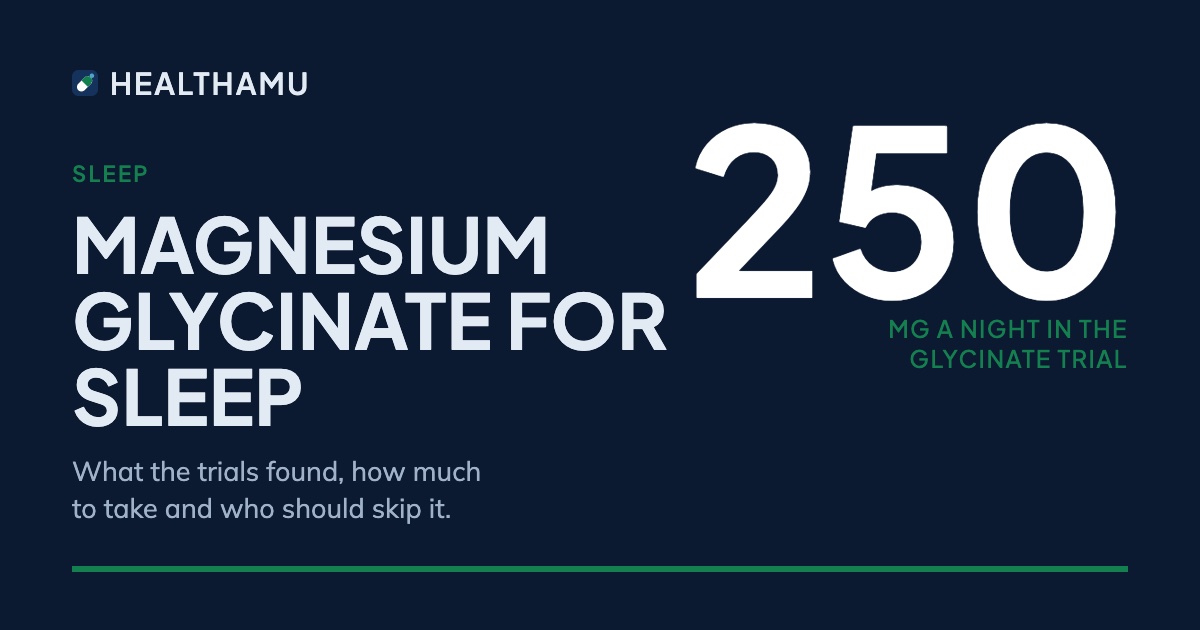
Magnesium glycinate may help sleep a little. In the only trial of this form, 155 adults with poor sleep took 250 mg of magnesium as bisglycinate before bed for 4 weeks, and insomnia scores fell slightly more than with placebo. NIH says research on magnesium for insomnia is still very limited. Stay under 350 mg a day from supplements, and try CBT-I first for chronic insomnia.
On this page
- Does magnesium glycinate help sleep?
- Does magnesium help you sleep? What the wider research says
- Which magnesium is best for sleep?
- How much magnesium glycinate for sleep should you take?
- Does magnesium make you sleepy?
- How does magnesium help sleep, in theory?
- Magnesium for sleep and anxiety: is there a link?
- Who should avoid magnesium glycinate for sleep?
- What do doctors use first for insomnia?
- Practical checklist before you try it
- Bottom line on magnesium glycinate for sleep
- FAQ
People ask about magnesium glycinate for sleep more than almost any other form, so we went to the research. We read the NCCIH pages on sleep supplements, the NIH Office of Dietary Supplements magnesium fact sheet, two systematic reviews, a 2026 review of 12 trials and the only randomized trial that tested magnesium glycinate on its own. You can see how we pick and grade sources on our how we review page.
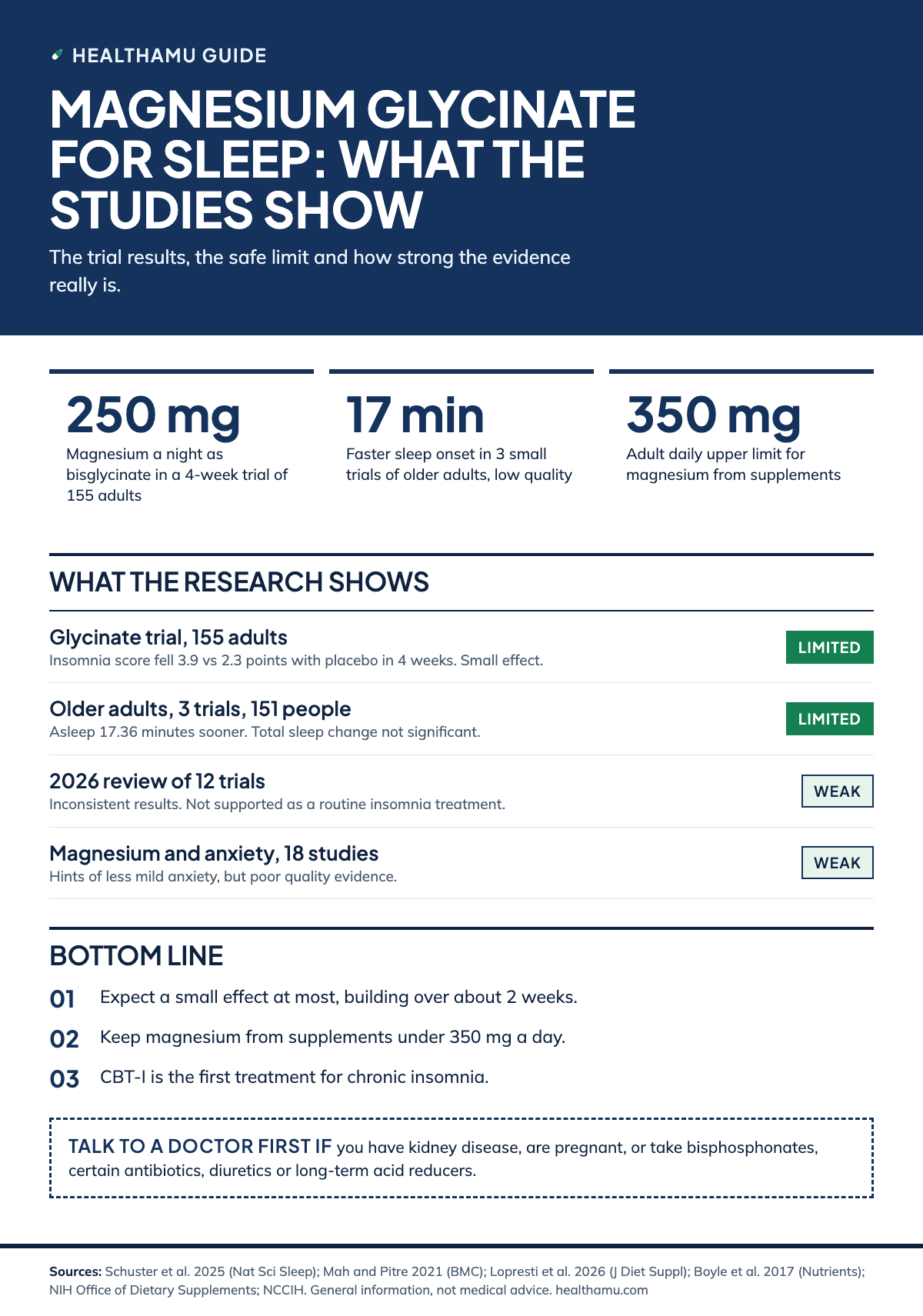
The short answer: in a 4-week trial of 155 adults, 250 mg of magnesium as bisglycinate improved insomnia scores a little more than placebo, a small effect, and NIH says there is still very little research on magnesium for insomnia.[6][2]
| What it is | Magnesium bound to the amino acid glycine. One trial capsule held 893 mg of the compound, which supplied 125 mg of magnesium and 761.5 mg of glycine.[6] |
|---|---|
| Studied for | Poor sleep and insomnia symptoms in adults. NCCIH calls the magnesium research for insomnia very limited.[1] |
| Amount tested | 250 mg of elemental magnesium a day, taken 30 to 60 minutes before bed, for 4 weeks.[6] |
| Best evidence | One randomized trial (155 adults): a small drop in insomnia scores versus placebo, effect size 0.2.[6] |
| Upper limit | 350 mg a day of magnesium from supplements and medicines for adults. Food magnesium does not count toward it.[3] |
| Main side effects | Diarrhea, nausea and cramping at high doses. Very high intakes can cause an irregular heartbeat.[1][3] |
| Check with a doctor first | Kidney disease, or if you take bisphosphonates, tetracycline or quinolone antibiotics, diuretics or long-term acid reducers.[3] |
Does magnesium glycinate help sleep?
Magnesium glycinate may help a little: the one trial that tested it alone found a small benefit over placebo after 4 weeks. German researchers gave 155 adults aged 18 to 65 who reported poor sleep either magnesium bisglycinate or a look-alike placebo.[6] Insomnia Severity Index scores fell 3.9 points with magnesium and 2.3 points with placebo.[6]
That gap was just statistically significant (p = 0.049). The authors rated the effect size as small (Cohen’s d = 0.2) and called the benefit modest.[6] Most of the change showed up within the first 14 days and held through week 4.[6]
The placebo group improved too, which is common in sleep trials. People who ate less magnesium at the start seemed to gain more, but that was an exploratory finding, not a tested result.[6] The trial measured sleep with questionnaires only, with no sleep lab or wearable data.[6]
Does magnesium help you sleep? What the wider research says
The wider research on magnesium and sleep is mixed and mostly low quality, so NIH does not treat it as an established sleep aid. NCCIH states there is very little research on magnesium for insomnia and not enough rigorous evidence to say whether it works.[1][2] It notes magnesium went viral through the “sleepy girl mocktail” trend on social media.[2]
A 2021 meta-analysis pooled 3 trials in 151 older adults. People taking magnesium fell asleep 17.36 minutes sooner than those on placebo. Total sleep rose by 16.06 minutes, but that change was not statistically significant, and the reviewers rated the evidence low to very low quality.[7]
A 2023 review of 9 studies with 7,582 people found that observational studies linked magnesium status with sleep, while the randomized trials disagreed with each other.[9] The newest review, published in 2026, looked at 12 randomized trials and concluded that current evidence does not support oral magnesium as a routine treatment for insomnia.[8]
Key trials and reviews
| Study | Who and how many | Dose and length | Result |
|---|---|---|---|
| Schuster 2025, randomized trial[6] | 155 adults, 18 to 65, poor sleep | 250 mg magnesium as bisglycinate, 4 weeks | Insomnia score fell 3.9 vs 2.3 points; small effect |
| Abbasi 2012, randomized trial[10] | 46 older adults with insomnia | 500 mg magnesium (oxide), 8 weeks | Better insomnia score and sleep onset; total sleep time not different |
| Mah and Pitre 2021, meta-analysis[7] | 3 trials, 151 older adults | 320 to 729 mg as oxide or citrate | Asleep 17.36 minutes sooner; low to very low quality |
| Arab 2023, systematic review[9] | 9 studies, 7,582 people | Diet and supplements | Observational links; trials contradictory |
| Lopresti 2026, systematic review[8] | 12 randomized trials in adults | Various forms and doses | Inconsistent; low to very low certainty |
Which magnesium is best for sleep?
No trial has compared magnesium forms head to head for sleep, so no form has been shown to be the best magnesium for sleep. Glycinate is the only form with its own sleep trial in adults with poor sleep.[6] The older-adult trials used magnesium oxide and magnesium citrate.[7]
On absorption, the NIH Office of Dietary Supplements says the aspartate, citrate, lactate and chloride forms tend to be better absorbed than magnesium oxide and sulfate.[3] Glycinate is not named in that list, so claims that it is the best-absorbed form go beyond the NIH summary.
ODS lists carbonate, chloride, gluconate and oxide as the forms most often reported to cause diarrhea.[3] In the glycinate trial, 93% of people reported no side effects at all.[6]
Is magnesium citrate for sleep worth trying?
Magnesium citrate was used in one of the three older-adult trials, at 320 mg a day for 8 weeks.[7] It is well absorbed, but magnesium salts can loosen stools, and one trial in the same review reported soft stools in every participant.[3][7]
Magnesium L-threonate has one 21-day trial in 80 adults that reported better sleep scores, but the paper came from the company that sells the ingredient, so treat it as early and industry-linked.[13]
How much magnesium glycinate for sleep should you take?
The only glycinate sleep trial used 250 mg of elemental magnesium a day, which sits under the 350 mg adult upper limit for supplemental magnesium.[6][3] That limit covers magnesium from supplements and medicines combined. Magnesium from food does not count, because healthy kidneys clear the extra.[3]
Older-adult trials used 320 to 729 mg of elemental magnesium a day.[7] Doses above 350 mg should only be taken with a clinician’s advice, and no trial shows that a higher dose works better for sleep.[1][3]
For context, the adult Recommended Dietary Allowance is 310 to 420 mg a day from all sources, depending on age and sex.[3] About 48% of Americans get less magnesium from food and drinks than they need on average.[3]
Worked example: reading a magnesium glycinate label
Look for the elemental magnesium figure on the label. Many labels also list the weight of the whole compound, which is a much larger number and easy to mistake for the dose.
- Find the line that says “magnesium” with an amount in mg. That is the elemental dose. The compound weight is usually shown in brackets next to “as magnesium bisglycinate”.
- In the trial capsule, 893 mg of magnesium bisglycinate supplied 125 mg of magnesium, about 14% by weight.[6]
- So a product listing “magnesium glycinate 1,000 mg” with no elemental figure may only deliver around 140 mg of magnesium, if its compound matches the trial’s. Blends vary, so check the label or ask the maker.
- Two of the trial capsules gave 250 mg of magnesium and 1,523 mg of glycine a day.[6]
- Add up every supplement and antacid you take that contains magnesium. Keep the total under 350 mg unless a clinician advises otherwise.[3]
Does magnesium make you sleepy?
There is no good evidence that magnesium works like a sedative or makes most people drowsy. In the glycinate trial, scores for daytime sleepiness and mood did not differ between the magnesium and placebo groups; only the insomnia score did.[6] The effects that do show up in trials are small and build over days or weeks.[6][7]
The glycinate trial asked people to take two capsules 30 to 60 minutes before bedtime, so that timing at least matches the research.[6] No trial has compared morning and evening doses.
If you feel very sleepy during the day, a supplement is unlikely to be the cause or the fix. NCCIH advises talking to a provider if you snore loudly, gasp or snort at night, or fight off sleepiness during the day, because these can be signs of sleep apnea.[1]
How does magnesium help sleep, in theory?
Researchers think magnesium may calm nerve signaling, and glycine may add a small effect of its own, but neither idea is proven in people. The glycinate trial authors suggest magnesium is the main active part and glycine may help, partly through effects on body temperature.[6]
Glycine has been tested alone. In a small study, 3 g of glycine before bed reduced next-day fatigue in healthy people whose sleep was cut short.[11] A daily glycinate dose like the trial’s supplies about half that much glycine, 1,523 mg.[6]
The other theory is about low intake. People who ate less magnesium seemed to gain more in the glycinate trial, and observational studies link magnesium status with sleep.[6][9] Neither finding proves that topping up magnesium fixes sleep.
Magnesium for sleep and anxiety: is there a link?
A 2017 review of 18 studies found hints that magnesium may ease mild anxiety in some groups, but the evidence was poor quality.[12] The studies looked at people already prone to anxiety, including mildly anxious adults and women with premenstrual symptoms.[12]
The glycinate sleep trial also measured mood and stress-related scores. It found no difference between magnesium and placebo on those other psychological outcomes.[6]
Anxiety that keeps you awake is common, and MedlinePlus notes that a type of counseling, cognitive behavioral therapy, can relieve the anxiety linked to chronic insomnia.[5] If worry is driving your sleep problems, that route has far more support than any supplement.
Who should avoid magnesium glycinate for sleep?
People with kidney problems should not take magnesium supplements without a doctor’s advice, because weak kidneys cannot clear excess magnesium.[3] High doses from supplements can cause diarrhea, nausea and stomach cramps, and extremely high intakes can lead to an irregular heartbeat and cardiac arrest.[1][3]
Magnesium also interacts with several medicines, according to ODS:[3]
- Osteoporosis drugs such as alendronate: take magnesium at least 2 hours apart.
- Tetracycline and quinolone antibiotics, such as doxycycline and ciprofloxacin: take the antibiotic at least 2 hours before or 4 to 6 hours after magnesium.
- Loop and thiazide diuretics can raise magnesium loss, while potassium-sparing diuretics reduce it.
- Proton pump inhibitors taken for more than about a year can cause low magnesium.
The glycinate trial excluded pregnant and breastfeeding women, so there is no sleep data for them.[6] If you are pregnant, nursing or take any prescription medicine, check with your doctor or pharmacist first. NHLBI advises talking to your provider before using dietary supplements for sleep.[4]
What do doctors use first for insomnia?
Cognitive behavioral therapy for insomnia, called CBT-I, is the treatment most strongly recommended for insomnia.[1] NHLBI describes it as a 6 to 8 week plan that is usually the first option for long-term insomnia, done in person, by phone or online.[4]
MedlinePlus says chronic insomnia lasts a month or longer and is most often caused by another problem, such as a medical condition, a medicine or another sleep disorder.[5] Treating that cause comes first.
Basic habits also help: go to bed and get up at the same time every day, and avoid caffeine, nicotine and alcohol close to bedtime.[4] Prescription medicines exist for short-term and longer-term use, and a doctor can explain their trade-offs.[4] Magnesium, at best, is a small add-on to these steps and never a replacement.
Practical checklist before you try it
- Check the label for elemental magnesium in mg, not just the compound weight. Our review method explains how we read supplement labels.
- Keep supplemental magnesium at or under 350 mg a day, including antacids and laxatives.[3]
- Match the trial if you try it: about 250 mg of magnesium, 30 to 60 minutes before bed, for 4 weeks.[6]
- Keep a simple sleep diary so you can judge whether anything changed.
- Space it at least 2 hours from bisphosphonates and follow the antibiotic timing above.[3]
- Get magnesium from food too: 1 ounce of pumpkin seeds has 156 mg, almonds 80 mg and half a cup of cooked spinach 78 mg.[3]
- Stop and see a doctor if you get ongoing diarrhea, or if poor sleep lasts a month or more.[3][5]
For more on other sleep topics, see our sleep guides, and compare other supplements in our ingredient guides.
Bottom line on magnesium glycinate for sleep
Magnesium glycinate is a reasonable, low-risk thing to try at about 250 mg a day if you have mild sleep trouble, no kidney disease and no clashing medicines. Expect a small change at most. The best trial showed a modest gain over placebo, and NIH still calls the evidence thin.[6][1]
For most people with ongoing insomnia, CBT-I and steady sleep habits are the better first step, because they have far stronger evidence than any magnesium form.[1][4] If you also eat few nuts, seeds, beans or greens, fixing your diet may do as much as a capsule.
Frequently asked questions
Does magnesium glycinate make you sleepy the next day?
The glycinate trial found no difference in daytime sleepiness between magnesium and placebo, and 93% of people reported no side effects. If you feel groggy, look at sleep length, other medicines or a possible sleep disorder first.
How long does magnesium glycinate take to work for sleep?
In the 4-week glycinate trial, most of the improvement in insomnia scores appeared within the first 14 days and then held steady. If nothing has changed after about 4 weeks, the supplement is unlikely to help you.
Can you take magnesium glycinate every night?
The trial gave 250 mg of magnesium nightly for 4 weeks without serious side effects. Longer use has not been studied for sleep. Keep supplemental magnesium under the 350 mg adult limit and check with a doctor if you have kidney disease.
Is magnesium L-threonate better than glycinate for sleep?
No study has compared them directly. One 21-day threonate trial in 80 adults reported better sleep scores, but it came from the ingredient's maker. Glycinate has one independent trial with a small benefit, so neither form has been shown to be better.
Can I get enough magnesium for sleep from food?
Many people can. One ounce of pumpkin seeds has 156 mg of magnesium, almonds 80 mg and half a cup of cooked spinach 78 mg. Food magnesium does not count toward the 350 mg supplement limit.
Sources
- Sleep Disorders and Complementary Health Approaches. NCCIH, 2024
- In the News: Magnesium Supplements for Sleep Disorders. NCCIH, 2024
- Magnesium: Fact Sheet for Health Professionals. NIH Office of Dietary Supplements, 2026
- Insomnia: Treatment. National Heart, Lung, and Blood Institute, 2022
- Insomnia. MedlinePlus, National Library of Medicine
- Magnesium Bisglycinate Supplementation in Healthy Adults Reporting Poor Sleep: A Randomized, Placebo-Controlled Trial. Schuster et al., Nature and Science of Sleep, 2025
- Oral magnesium supplementation for insomnia in older adults: a Systematic Review and Meta-Analysis. Mah and Pitre, BMC Complementary Medicine and Therapies, 2021
- Magnesium Supplementation for Sleep in Adults: A Systematic Review of Randomized Controlled Trials. Lopresti et al., Journal of Dietary Supplements, 2026
- The Role of Magnesium in Sleep Health: a Systematic Review of Available Literature. Arab et al., Biological Trace Element Research, 2023
- The effect of magnesium supplementation on primary insomnia in elderly: A double-blind placebo-controlled clinical trial. Abbasi et al., Journal of Research in Medical Sciences, 2012
- The effects of glycine on subjective daytime performance in partially sleep-restricted healthy volunteers. Bannai et al., Frontiers in Neurology, 2012
- The Effects of Magnesium Supplementation on Subjective Anxiety and Stress: A Systematic Review. Boyle et al., Nutrients, 2017
- Magnesium-L-threonate improves sleep quality and daytime functioning in adults with self-reported sleep problems: A randomized controlled trial. Hausenblas et al., Sleep Medicine: X, 2024 (industry-linked)

Lucie Bricks is the Reviews Editor at Healthamu, a buyer's guide for supplements sold through online ads. Lucie reads the full label, sets each dose beside the doses used in human studies, grades the research with sources such as the NIH Office of Dietary Supplements and NCCIH, and works out the real cost per day, refund terms and checkout fine print. Lucie is not a doctor, dietitian, nurse or pharmacist. Reviews give pros, cons and who a product suits, never scores. How we review supplements.
This article is general information, not medical advice. Dietary supplements are not reviewed by the FDA for safety or effectiveness before they are sold. Talk to your doctor before you start any supplement, especially if you are pregnant, nursing, take medication or have a health condition.