Boswellia extract and collagen have the best evidence for joint pain, with small but consistent benefits for knee osteoarthritis in pooled trials of 545 and 2,856 people. Turmeric, ginger and chondroitin have limited support. Glucosamine, fish oil and vitamin D did not beat placebo or a low dose in large trials. Exercise and weight loss still come first.
On this page
- What is the best supplement for joint pain?
- 1. Boswellia: the best-tested herb for knee pain?
- 2. Collagen: a good fit if you want few side effects?
- 3. Turmeric (curcumin): worth it if you skip the strong forms?
- 4. Ginger extract: helpful if your stomach tolerates it?
- 5. Chondroitin: the better pick for hand arthritis?
- 6. Glucosamine: why do most guidelines say skip it?
- Which joint supplements are not worth your money?
- What do doctors use first for joint pain?
- Who should avoid joint supplements?
- How do you choose a joint supplement?
- Bottom line
- FAQ
To find the best supplement for joint pain, we read the NCCIH pages on osteoarthritis, glucosamine, turmeric and boswellia, the 2019 American College of Rheumatology guideline, MedlinePlus, and nine trials and reviews[1][2][3][4][5][6]. We graded each ingredient type by what those studies found, using the method on our how we review supplements page.
The short answer: boswellia extract and collagen have the most consistent small benefits for knee osteoarthritis pain, in pooled analyses of 7 and 25 trials[9][12]. No supplement beats exercise, weight loss and standard pain relievers, which the ACR guideline puts first[6].
| What this ranks | Ingredient types sold for joint pain, graded by trial results in osteoarthritis, not brands[1] |
|---|---|
| Best supported | Boswellia extract (7 trials, 545 people) and collagen (25 trials, 2,856 people in the main analysis)[9][12] |
| Amounts used in trials | Boswellia up to 1,000 mg a day; curcumin about 1,000 mg a day; glucosamine 1,500 mg and chondroitin 1,200 mg a day[4][10][7] |
| Weakest results | Glucosamine, fish oil and vitamin D did not beat their comparison groups in large trials[7][13][14] |
| Main safety flags | High-absorption curcumin has been linked to liver harm; glucosamine and chondroitin may raise bleeding risk with warfarin[3][2] |
| Who should ask first | People who are pregnant, take warfarin, or have diabetes[3][2] |
| What doctors use first | Exercise, weight loss, tai chi, topical and oral NSAIDs, and steroid injections for the knee[6] |
What is the best supplement for joint pain?
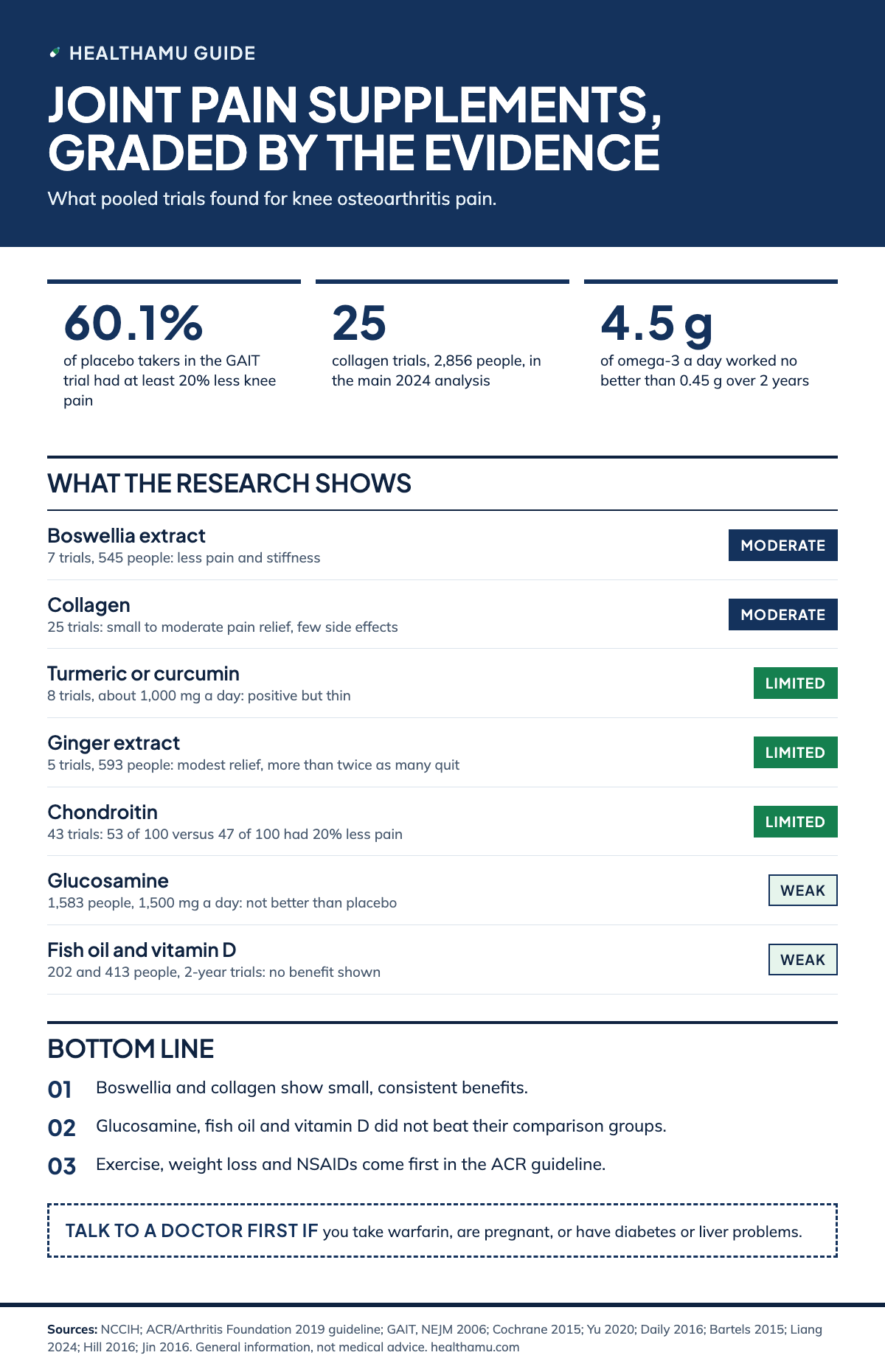
On current evidence, the best supplement for joint pain is a boswellia extract or a collagen product, and both give small benefits. In pooled trials of people with knee osteoarthritis, each lowered pain scores a little more than the comparison group[9][12]. Neither one replaces exercise or standard pain medicine[6].
Most of this research is on knee osteoarthritis, the wear-and-tear kind of arthritis. There is much less data for hips, hands and other joints[2]. If your pain comes from an injury, gout or rheumatoid arthritis, these results may not apply to you.
We used four grades, and each one describes the quality of the research behind an ingredient.
| Grade | What it means |
|---|---|
| Moderate | Several pooled trials, with a small but consistent effect |
| Limited | Some trials, but small, low quality or mixed |
| Weak | Pilot studies only, or large trials and reviews found no benefit |
| Avoid | No evidence of benefit plus a safety problem |
Here is what the main studies found for each ingredient.
| Ingredient and study | People | Dose and length | What happened |
|---|---|---|---|
| Boswellia, 2020 review[9] | 7 trials, 545 people | Various extracts, at least 4 weeks advised | Pain fell 8.33 points more than control on a visual pain scale |
| Collagen, 2024 review[12] | 25 trials, 2,856 people | Various collagen forms | Small to moderate pain relief, no more side effects than control |
| Turmeric or curcumin, 2016 review[10] | 8 trials | About 1,000 mg curcumin a day | Lower pain scores, but too few trials for firm conclusions |
| Ginger, 2015 review[11] | 5 trials, 593 people | Ginger extract by mouth | Modest pain relief; more than twice as many people quit |
| Chondroitin, 2015 Cochrane review[8] | 43 trials | 1 month to 3 years | 53 of 100 got 20% less pain, versus 47 of 100 on placebo |
| Glucosamine, GAIT trial 2006[7] | 1,583 people | 1,500 mg a day for 24 weeks | Not significantly better than placebo |
| Fish oil, 2016 trial[13] | 202 people | 4.5 g versus 0.45 g omega-3 a day for 2 years | High dose gave no extra benefit |
| Vitamin D, 2016 trial[14] | 413 people | 50,000 IU a month for 2 years | No change in knee pain or cartilage |
1. Boswellia: the best-tested herb for knee pain?
Boswellia serrata is a tree resin extract, and it has the most consistent trial support of the herbs sold for joint pain. A 2020 review pooled 7 trials with 545 people and found less pain and stiffness and better joint function than in the control groups[9]. Our grade: Moderate.
NCCIH adds a caution: most boswellia studies are small and of low quality[4]. An NCCIH summary of a 2014 review found that boswellia may give slight improvements in pain and function, small enough that some patients might not notice them[1].
Boswellia has a good safety record in research. Doses up to 1,000 mg a day were used safely in trials lasting up to 6 months[4]. The 2020 review suggests taking it for at least 4 weeks before judging the result[9].
It suits adults with knee osteoarthritis who want to try one herb with decent data. If you are pregnant, breastfeeding or take asthma medicine, talk with your provider first[4].
2. Collagen: a good fit if you want few side effects?
Collagen supplements are proteins taken from animal connective tissue, and a large 2024 review found they ease osteoarthritis pain a little. The review covered 35 trials and 3,165 people, with a main analysis of 25 trials and 2,856 people[12]. Our grade: Moderate.
The effect on pain was small to moderate, and the authors rated the certainty as moderate. Collagen also improved joint function. People taking it did not drop out or report side effects more often than the comparison groups[12].
The review grouped several kinds of collagen together. Its summary does not name one best form or dose, so treat any label that claims a precise “clinical dose” with care. We left out claims about rebuilding cartilage, because the trials we read measured pain and function.
Collagen makes sense for people with knee osteoarthritis who had stomach trouble with other options.
3. Turmeric (curcumin): worth it if you skip the strong forms?
Curcumin is the main active compound in turmeric root, and early trials for arthritis pain look positive but thin. A 2016 review of 8 trials found lower pain scores with about 1,000 mg of curcumin a day[10]. Our grade: Limited.
The authors said the number of trials, the sample sizes and the study quality were not enough for definite conclusions. In five studies that compared curcumin with pain medicine, they found no significant difference between the two[10]. NCCIH calls the early evidence for osteoarthritis positive but says better studies are needed[3].
Plain turmeric is likely safe for 2 to 3 months. Products made to boost absorption have been linked to liver damage[3]. Stop and call your provider if you notice dark urine, yellow skin, nausea or fatigue. Turmeric supplements may be unsafe in pregnancy[3].
4. Ginger extract: helpful if your stomach tolerates it?
Ginger extract gave a modest drop in osteoarthritis pain in a 2015 review, but more people quit taking it. The review pooled 5 trials with 593 people. Pain and disability both improved a little compared with placebo[11]. Our grade: Limited.
Many people did not tolerate it. People on ginger were more than twice as likely to stop treatment as those on placebo[11]. The authors judged the evidence to be of moderate quality, held back by small numbers and gaps in how the trials handled dropouts.
Ginger is worth a try for people who already handle it well in food. If heartburn or an upset stomach shows up, stop and try another option on this list.
5. Chondroitin: the better pick for hand arthritis?
Chondroitin is a natural part of cartilage, and its best case is hand osteoarthritis rather than the knee. The 2019 ACR guideline conditionally recommends chondroitin for hand osteoarthritis but strongly recommends against it for the knee or hip[2][6]. Our grade: Limited.
A Cochrane review of 43 trials found that 53 of 100 people taking chondroitin got at least 20% less knee pain, compared with 47 of 100 on placebo[8], a small gap. Shorter studies showed more benefit, but those results varied widely and the evidence was rated low quality[8].
In the large GAIT trial, chondroitin at 1,200 mg a day was not significantly better than placebo for knee pain[7]. For hands, NCCIH describes a 6-month trial of 162 people in which hand pain and function improved more with chondroitin[2].
Chondroitin may raise bleeding risk if you take warfarin[2].
6. Glucosamine: why do most guidelines say skip it?
Glucosamine is the most sold joint supplement, yet the biggest US trial found it did not beat placebo for knee pain. In GAIT, 1,583 people took 1,500 mg a day, chondroitin, both, the drug celecoxib, or placebo for 24 weeks[7]. Our grade: Weak.
The placebo group did well: 60.1% had at least 20% less pain. Glucosamine added only 3.9 percentage points, which was not significant. Celecoxib added 10.0 points, which was[7]. A subgroup with moderate to severe pain did better on the combination, but the authors called this an exploratory finding[7].
The 2019 ACR guideline strongly recommends against glucosamine for knee or hip osteoarthritis[2]. NCCIH notes that the more positive studies often used a prescription form, had a high risk of bias, and were funded by the drug maker[2]. Glucosamine may also raise blood sugar in some people[2].
Which joint supplements are not worth your money?
Fish oil and vitamin D did not ease knee pain in long trials, and imported “arthritis” pills with hidden drugs are a real safety risk. These three groups sit at the bottom of our list. The first two scored Weak, and the hidden-drug products scored Avoid[13][14][1].
7. Fish oil: Weak
A 2-year trial gave 202 people with knee osteoarthritis either 4.5 g or 0.45 g of omega-3 fats a day. The high dose gave no extra benefit, and cartilage loss was the same in both groups[13]. The trial had no placebo group, so it cannot show whether either dose helped. It does show that taking ten times more did not help more.
8. Vitamin D: Weak
A trial in 413 people with knee osteoarthritis and low vitamin D gave 50,000 IU a month or placebo for 2 years. Blood levels rose, but knee pain and cartilage volume did not change compared with placebo[14]. Side effects were reported by 56 people on vitamin D and 37 on placebo[14]. Vitamin D still matters for bone health when your level is low.
9. Imported “arthritis” pills with hidden drugs: Avoid
The FDA has warned about several supplements sold for arthritis or pain that were tainted with prescription drugs. NCCIH notes these hidden ingredients can cause side effects or interact with your medicines[1]. Be wary of any product that promises fast, dramatic relief, since no supplement in this guide showed that in trials.
What do doctors use first for joint pain?
Doctors start osteoarthritis care with movement, weight control and proven pain relievers, not supplements. The 2019 ACR guideline strongly recommends exercise, weight loss for people who are overweight, tai chi, self-management programs, a cane, topical NSAIDs for the knee, oral NSAIDs, and steroid injections for the knee[6].
MedlinePlus adds that acetaminophen or an NSAID can help symptoms, with a limit of 4,000 mg of acetaminophen a day from all sources[5]. Physical therapy builds strength and motion. If it does not help after 6 to 12 weeks, it likely will not[5]. Joint replacement is an option for severe cases[5].
Any supplement you add belongs on top of this plan. Tell every provider you see which supplements you take, so they can check for interactions[1].
Who should avoid joint supplements?
People who are pregnant, take warfarin, or have diabetes or liver problems should talk to a provider before starting any joint supplement. Each group has a specific risk tied to one or more ingredients on this list[2][3].
- Pregnancy and breastfeeding: turmeric supplements may be unsafe in pregnancy, and little is known about medicinal doses of boswellia, glucosamine or chondroitin[3][4][2].
- Warfarin users: glucosamine and chondroitin have been linked to higher bleeding risk[2].
- Diabetes: glucosamine may raise blood sugar in some people[2].
- Liver concerns: high-absorption curcumin products have been tied to liver injury[3].
- Sensitive stomach: ginger caused more dropouts than placebo, and turmeric can cause nausea, reflux or diarrhea[11][3].
Stop turmeric or curcumin right away and call your provider if you notice fatigue, nausea, poor appetite, dark urine or yellowing skin[3].
How do you choose a joint supplement?
Pick one ingredient that fits your joint and your health, and stop it if your pain has not changed after a fair trial. Trials that showed a benefit ran for at least 4 weeks, and some ran for months[9][7]. The table below matches common situations with a sensible first step.
| Your situation | Reasonable first try | Why |
|---|---|---|
| Knee osteoarthritis, no other health issues | Boswellia extract | Most consistent herbal data, good safety record[9][4] |
| Knee pain and a sensitive stomach | Collagen | No more side effects than control in 25 trials[12] |
| Hand osteoarthritis | Chondroitin | Conditionally recommended for hands by the ACR[6] |
| You take warfarin | Ask your provider before any of these | Glucosamine and chondroitin may raise bleeding risk[2] |
| You are pregnant | Skip turmeric and ask first about the rest | Turmeric supplements may be unsafe in pregnancy[3] |
| You already take glucosamine with no change | Stop it and talk to your provider | It did not beat placebo in GAIT[7] |
Before you buy, run through these label checks:
- Choose a single-ingredient product so you can tell what works.
- Check the form: glucosamine is sold as sulfate or hydrochloride, and the trials did not all use the same one[2].
- Avoid curcumin labeled as enhanced or high absorption if you have any liver concerns[3].
- Compare the dose on the label with the amounts used in trials, such as up to 1,000 mg of boswellia a day[4].
- Walk away from products that claim to rebuild cartilage or work overnight.
- Read more ingredient breakdowns in our joint health guides and the rest of our best supplement guides.
Bottom line
For most people with knee osteoarthritis, the best first step is exercise and weight control, because the ACR guideline backs them strongly and no supplement comes close[6]. If you still want a supplement, boswellia or collagen has the best support, and the benefit is small[9][12].
Skip glucosamine, fish oil and vitamin D for joint pain alone, since large trials found no clear benefit[7][13][14]. If you try one, give it at least 4 weeks, tell your provider, and stop if your pain stays the same[9].
Frequently asked questions
Is the best joint supplement different for men and women?
None of the reviews we read gave separate advice for men or women. The GAIT trial enrolled both, and 64% of its 1,583 people were women. Pick by your joint, your health and your other medicines rather than by sex.
What vitamins are good for joints?
No vitamin has shown a clear benefit for joint pain. In a 2-year trial of 413 people with knee osteoarthritis and low vitamin D, monthly high-dose vitamin D did not change knee pain or cartilage. Vitamin D still matters for bone health if your level is low.
Are there supplements for cartilage repair?
No supplement has been shown to rebuild cartilage. Vitamin D did not change cartilage volume over 2 years, and fish oil at a high dose did no better than a low dose. NCCIH says studies of glucosamine and chondroitin on joint structure have conflicting results.
How long do joint supplements take to work?
Give one product at least 4 weeks, the minimum a 2020 boswellia review suggested. Large trials such as GAIT ran for 24 weeks. If your pain has not changed after a fair trial, stop and talk with your provider about other options.
Are joint supplements safe with blood thinners?
Glucosamine and chondroitin have been linked to a higher risk of bleeding in people taking warfarin, according to NCCIH. If you take any blood thinner, ask your doctor or pharmacist before you start a joint supplement, and mention it at every visit.
Sources
- Osteoarthritis: In Depth. NCCIH, National Institutes of Health
- Glucosamine and Chondroitin for Osteoarthritis: What You Need To Know. NCCIH, National Institutes of Health
- Turmeric: Usefulness and Safety. NCCIH, National Institutes of Health
- Boswellia: Usefulness and Safety. NCCIH, National Institutes of Health
- Osteoarthritis. MedlinePlus, National Library of Medicine
- 2019 American College of Rheumatology/Arthritis Foundation Guideline for the Management of Osteoarthritis of the Hand, Hip, and Knee. Kolasinski et al., Arthritis and Rheumatology, 2020
- Glucosamine, chondroitin sulfate, and the two in combination for painful knee osteoarthritis (GAIT). Clegg et al., New England Journal of Medicine, 2006
- Chondroitin for osteoarthritis. Singh et al., Cochrane Database of Systematic Reviews, 2015
- Effectiveness of Boswellia and Boswellia extract for osteoarthritis patients: a systematic review and meta-analysis. Yu et al., BMC Complementary Medicine and Therapies, 2020
- Efficacy of Turmeric Extracts and Curcumin for Alleviating the Symptoms of Joint Arthritis: A Systematic Review and Meta-Analysis. Daily et al., Journal of Medicinal Food, 2016
- Efficacy and safety of ginger in osteoarthritis patients: a meta-analysis of randomized placebo-controlled trials. Bartels et al., Osteoarthritis and Cartilage, 2015
- Efficacy and safety of collagen derivatives for osteoarthritis: A trial sequential meta-analysis. Liang et al., Osteoarthritis and Cartilage, 2024
- Fish oil in knee osteoarthritis: a randomised clinical trial of low dose versus high dose. Hill et al., Annals of the Rheumatic Diseases, 2016
- Effect of Vitamin D Supplementation on Tibial Cartilage Volume and Knee Pain Among Patients With Symptomatic Knee Osteoarthritis. Jin et al., JAMA, 2016

Lucie Bricks is the Reviews Editor at Healthamu, a buyer's guide for supplements sold through online ads. Lucie reads the full label, sets each dose beside the doses used in human studies, grades the research with sources such as the NIH Office of Dietary Supplements and NCCIH, and works out the real cost per day, refund terms and checkout fine print. Lucie is not a doctor, dietitian, nurse or pharmacist. Reviews give pros, cons and who a product suits, never scores. How we review supplements.
This article is general information, not medical advice. Dietary supplements are not reviewed by the FDA for safety or effectiveness before they are sold. Talk to your doctor before you start any supplement, especially if you are pregnant, nursing, take medication or have a health condition.