Receded gum tissue does not grow back on its own, so fixing receding gums means stopping the cause and covering roots if needed. Get a gum exam, treat any gum disease with deep cleaning, brush gently with a soft brush, clean between teeth daily and quit tobacco. If roots stay exposed or sensitive, a periodontist can place a gum graft.
On this page
- How to fix receding gums: 7 steps in order
- What causes receding gums?
- Receding gums vs gum disease: are they the same thing?
- Can receding gums grow back?
- What gum recession treatment do dentists use first?
- How does gum repair for receding gums work?
- What is the best toothpaste for receding gums?
- When should you see a dentist about receding gums?
- Daily checklist for receding gums
- Bottom line
- FAQ
How to fix receding gums depends on why they are pulling back, so we started there. We read the NIH dental institute page on gum disease, two MedlinePlus pages, two ADA patient pages, two American Academy of Periodontology pages and seven reviews, including two Cochrane reviews. Our review process explains how we pick and check sources.
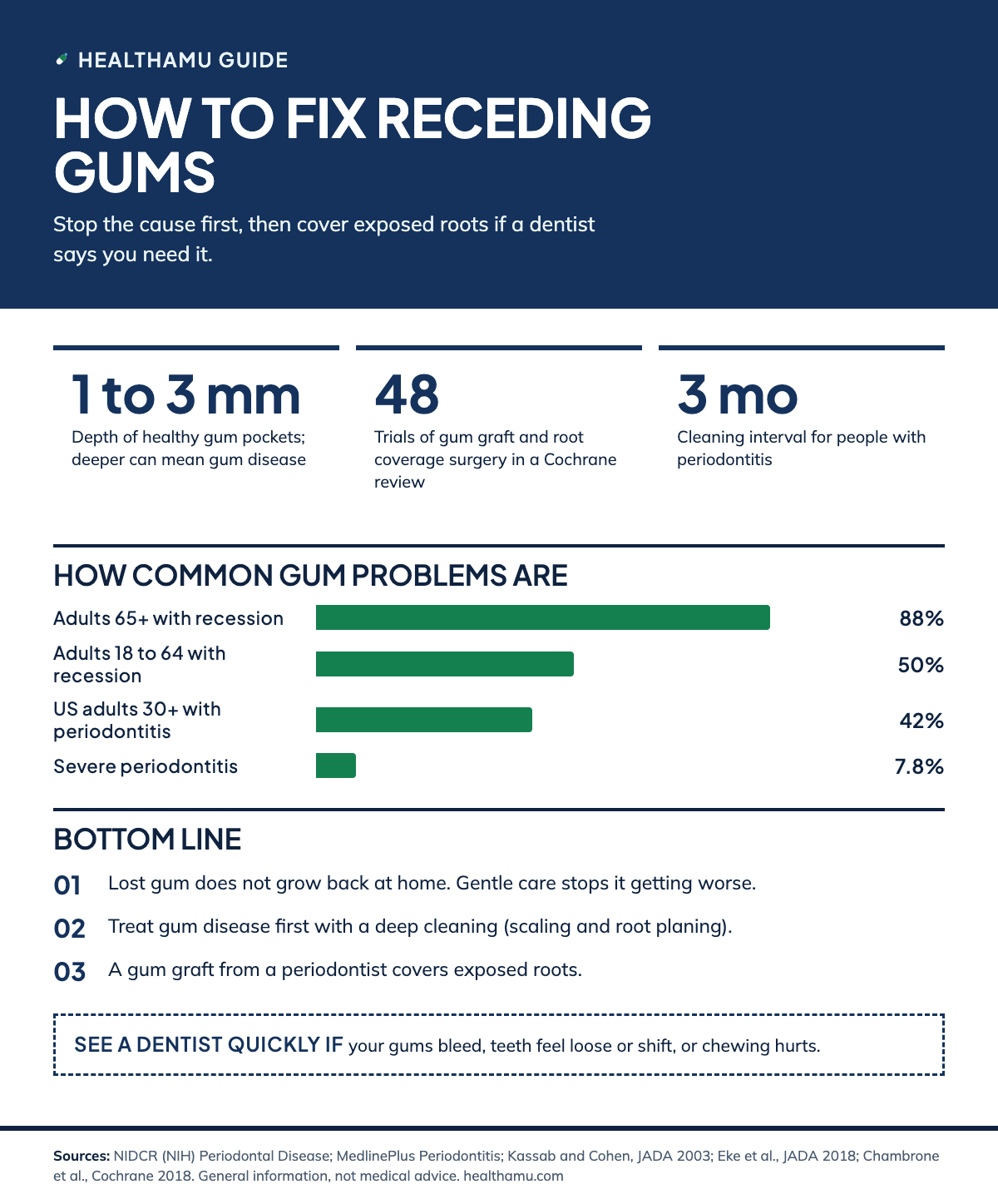
The short answer: you cannot regrow lost gum at home, but you can stop recession from getting worse with gentle cleaning and dental care, and a gum graft can cover exposed roots. About half of adults aged 18 to 64 already have at least one receded spot[8].
| What it is | The gum edge moves down the tooth and exposes the root, so teeth look longer[1] |
|---|---|
| How common | 88% of adults 65 and older and 50% of adults 18 to 64 have one or more sites[8] |
| Main causes | Gum disease, tobacco, hard brushing, crooked teeth and genetics[5][8] |
| First treatment | Deep cleaning (scaling and root planing) and better daily care[1] |
| Repair for lost gum | Gum graft or other root coverage surgery by a periodontist[6][7] |
| Best evidence | A 2018 Cochrane review of 48 trials of root coverage surgery[9] |
| Who should not wait | Anyone with bleeding, loose or shifting teeth, or pain when chewing[1] |
How to fix receding gums: 7 steps in order
Fixing receding gums means two jobs: stopping the cause so the gum line holds, then covering exposed roots with surgery if a dentist says you need it. Home care does the first job. Only a dental procedure does the second[6][7]. These steps follow the order dentists use.
- Book a gum exam. A dentist measures the pockets around each tooth with a small probe. Healthy pockets are usually 1 to 3 mm deep. Deeper pockets point to gum disease[1].
- Treat any gum disease first. If you have periodontitis, the usual first step is scaling and root planing, a deep clean under the gum line[1][3].
- Switch to a soft toothbrush. A 2019 review of 13 studies found hard bristles caused more gum injuries than medium or soft ones[12]. Brush gently, twice a day, with fluoride toothpaste[1].
- Clean between your teeth every day. Use floss, an interdental brush, a pick or a water flosser your dentist recommends[1].
- Stop smoking or chewing tobacco. Tobacco is the biggest risk factor for gum disease, and it makes treatment work less well[1].
- Calm sensitive roots. Use a desensitizing toothpaste for several weeks, or ask about an in-office fluoride gel[4][11].
- Ask about a graft if roots stay exposed. A periodontist can move gum tissue from the palate or a donor source to cover the root[7].
Steps 1 and 2 matter most. If gum disease is driving the recession, nothing else holds until the infection is controlled[1].
What causes receding gums?
Receding gums usually come from gum disease, tobacco use, rough brushing, or teeth that sit out of line, and several causes often work together. A review in the Journal of the American Dental Association linked recession to trauma, sex, tooth position, inflammation and tobacco[8].
The same review found recession in people with good hygiene and in people with poor hygiene[8]. So clean teeth do not rule it out. Brushing too hard can wear the gum back even in a healthy mouth.
The ADA lists more risk factors for gum disease: genetics, crooked teeth that are hard to keep clean, pregnancy, diabetes and some medicines. Those medicines include steroids, some anti-seizure drugs, some calcium channel blockers and birth control pills[5].
Recession also becomes more common and more extensive as people get older[8]. That is why the numbers jump from half of working-age adults to 88% of people over 65.
Receding gums vs gum disease: are they the same thing?
No. Gum recession is a sign you can see, while gum disease (periodontitis) is an infection that can cause it. You can have recession without active infection, for example from hard brushing. You can also have gum disease with little visible recession at first[1][8].
With periodontitis, the gums pull away from the teeth and form pockets that become infected[2]. Over time the infection breaks down the bone and tissue that hold teeth in place. MedlinePlus calls it the main cause of tooth loss in adults[3].
It is common. A national survey estimated that 42% of US adults aged 30 and older with teeth had periodontitis, and 7.8% had a severe form[13].
To tell them apart, a dentist checks for bleeding and swelling, measures pocket depth, asks about tobacco use and diabetes, and may take X-rays[1]. An X-ray can show bone loss that you cannot see in a mirror[1].
Treatment depends on which one you have. If infection is present, deep cleaning comes first. If the gums are healthy but thin or worn, the focus is on brushing habits and, sometimes, a graft.
Can receding gums grow back?
Gum tissue that has receded does not grow back on its own, and no toothpaste or rinse has been shown to regrow it. What you can do is stop it from receding further. Lost tissue can then be covered with surgery[6][7].
Early gum disease can improve. Gingivitis, the mild stage, can often be reversed with daily brushing, flossing and regular cleanings[1][2]. Swelling and bleeding go down. But a gum line that has already moved down the root stays where it is.
That is why the AAP describes gum grafts as a way to cover exposed roots, reduce further recession and protect roots from decay[6]. Be wary of any product that promises gum regrowth. We found no review that supports that claim.
Repair results are measured in millimeters of root covered. The Cochrane review only included recession of 3 mm or more, and followed people for at least 6 months[9]. Ask your dentist whether small, stable recession needs surgery at all, or only watching.
What gum recession treatment do dentists use first?
The first gum recession treatment is usually a deep cleaning called scaling and root planing, plus coaching on daily care, when gum disease is present. The goal is to control infection before anything else[1].
In scaling, the dentist or hygienist removes plaque and tartar from below the gum line. Root planing smooths the root so plaque has a harder time sticking again[1]. Your dentist may also prescribe a medicated rinse[1].
After treatment, bleeding and tenderness should fade within 3 to 4 weeks. People with periodontitis should have a professional cleaning every 3 months[3].
Any treatment works only if you keep up good daily care at home. Quitting tobacco also improves results[1].
If pockets stay deep, surgery may be needed to clean them or rebuild support[1][3]. For exposed roots, the usual receding gums treatment is root coverage surgery, covered in the next section.
Other options include bonding or fluoride gel for sensitive roots, and orthodontic treatment when a tooth sits out of line[4][8].
How does gum repair for receding gums work?
Gum repair for receding gums is root coverage surgery: a periodontist moves gum tissue from your palate or a donor source over the exposed root. It can be done on one tooth or several, and it may reduce sensitivity[7].
The most common method pairs a connective tissue graft with a flap that is moved up over the root. Other versions use donor skin matrix, collagen or enamel matrix proteins in place of tissue from your palate[9][10].
Periodontists train for three more years after dental school and can use sedation or anesthesia during gum surgery[7]. Here is what the main reviews found.
| Review | What was studied | Size | Main finding |
|---|---|---|---|
| Cochrane, Chambrone 2018[9] | Root coverage surgery for recession of 3 mm or more, followed 6+ months | 48 trials | Connective tissue graft gave a slight edge; donor matrix came closest. Evidence quality low. |
| AAP workshop, Chambrone and Tatakis 2015[10] | All root coverage methods | 234 trials | All methods reduced recession depth; tissue graft methods did best. Smoking may hurt results. |
| Kassab and Cohen 2003[8] | Survey studies on causes and treatment | Narrative review | Grafts, guided tissue regeneration and orthodontics can improve looks and sensitivity. |
The evidence is thin, though. In the Cochrane review, only 1 of the 48 trials was judged low risk of bias[9]. Each method helps to some degree, and the gaps between them are small and uncertain.
What is the best toothpaste for receding gums?
The best toothpaste for receding gums is a fluoride toothpaste, and if exposed roots are sensitive, a desensitizing formula with stannous fluoride, potassium, arginine or calcium sodium phosphosilicate. None of these regrows gum. They protect roots and calm pain[1][11].
A 2020 network meta-analysis pooled 125 trials with 12,541 patients. Calcium sodium phosphosilicate, stannous fluoride, potassium and arginine all beat a standard fluoride paste for sensitivity. Calcium sodium phosphosilicate came out best across all three pain tests[11].
An older Cochrane review was more cautious about potassium alone. Across 6 studies, potassium nitrate cut sensitivity to air and touch at 6 to 8 weeks, but people’s own ratings did not show a clear change[14].
The ADA notes that a desensitizing toothpaste usually needs several applications before it helps[4]. Give it a few weeks. If pain lasts, see a dentist, because decay, a cracked tooth or a worn filling can feel the same[4].
| Your situation | Toothpaste to look for |
|---|---|
| Recession, no sensitivity | Any fluoride toothpaste[1] |
| Recession with cold or air sensitivity | Stannous fluoride, potassium, arginine or calcium sodium phosphosilicate[11] |
| Sensitivity that lasts past a few weeks | See a dentist; you may need fluoride gel, bonding or a graft[4] |
When should you see a dentist about receding gums?
See a dentist soon if your gums are receding, and quickly if you also have bleeding, loose teeth or pain when you chew. These are signs of gum disease that needs professional care[1].
Book an urgent visit if you notice:
- Gums that bleed easily or look red and swollen[1]
- Teeth that feel loose or are shifting[1][3]
- Pain when chewing[1]
- Bad breath that will not go away[1]
- A change in how your teeth fit together when you bite[5]
In advanced gum disease, the bone that supports the teeth can be destroyed, and teeth may become loose or need to be removed[1].
Some groups need closer checks. Smokers, people with diabetes and people taking steroids, some anti-seizure drugs, some calcium channel blockers or birth control pills have a higher risk of gum disease[1][5]. Pregnancy raises the risk as well[5].
Gum surgery has normal surgical risks. Talk with your periodontist about recovery and any blood thinners or other medicines you take before a graft. Do not stop a prescribed medicine on your own.
Daily checklist for receding gums
- Brush twice a day with a soft or extra-soft brush and fluoride toothpaste[1][12]
- Use light pressure and small strokes, not hard scrubbing[12]
- Clean between teeth once a day with floss or an interdental brush[1]
- Pick a desensitizing toothpaste if roots feel sensitive, and give it several weeks[4][11]
- Quit all forms of tobacco[1]
- Keep regular checkups; every 3 months if you have periodontitis[3]
- Ask your dentist to note your pocket depths so you can track change[1]
More guides on gum care are in our teeth and gums section.
Bottom line
Receding gums are common and usually slow. You cannot regrow lost gum at home, but you can stop the slide with a soft brush, daily cleaning between teeth, no tobacco and treatment for any gum disease[1][12].
For most people, a gum exam and a deep cleaning, if needed, is the better first step than any product, because recession caused by infection will keep going until the infection is treated. If roots stay exposed or sensitive after that, a gum graft is the repair with the most research behind it[9][10].
Frequently asked questions
How common are receding gums?
Very common. A review in the Journal of the American Dental Association found that 88% of people aged 65 and older and 50% of people aged 18 to 64 have at least one site where the gum has receded.
Can a hard toothbrush cause receding gums?
It can add to the problem. A 2019 review of 13 studies found hard-bristle brushes caused more gum injuries than medium or soft ones, and concluded that soft and extra-soft brushes tend to be safer for your gums.
Do receding gums cause sensitive teeth?
Often, yes. When gums recede, the root surface and the dentin under it are exposed. Heat, cold and acidic foods can then reach the nerve, which causes sharp pain. A desensitizing toothpaste or a graft can help.
Does smoking cause receding gums?
Smoking is the biggest risk factor for gum disease, a main cause of recession, according to the NIH dental institute. Tobacco also slows healing, and a large review found smoking may reduce the success of gum graft surgery.
How often should you see a dentist with receding gums?
Follow your dentist's plan. MedlinePlus advises a professional cleaning every 3 months for people with periodontitis. Others usually keep routine checkups so the dentist can measure pocket depth and track any change.
Sources
- Periodontal (Gum) Disease. National Institute of Dental and Craniofacial Research (NIH)
- Gum Disease. MedlinePlus, National Library of Medicine
- Periodontitis. MedlinePlus Medical Encyclopedia
- Sensitive Teeth. American Dental Association, MouthHealthy
- Gum Disease. American Dental Association, MouthHealthy
- Cosmetic Procedures. American Academy of Periodontology
- Surgical Procedures. American Academy of Periodontology
- The etiology and prevalence of gingival recession. Kassab and Cohen, J Am Dent Assoc, 2003
- Root coverage procedures for treating localised and multiple recession-type defects. Chambrone et al., Cochrane Database Syst Rev, 2018
- Periodontal soft tissue root coverage procedures: a systematic review from the AAP Regeneration Workshop. Chambrone and Tatakis, J Periodontol, 2015
- Desensitizing Toothpastes for Dentin Hypersensitivity: A Network Meta-analysis. Martins et al., J Dent Res, 2020
- Are bristle stiffness and bristle end-shape related to adverse effects on soft tissues during toothbrushing?. Ranzan et al., Int Dent J, 2019
- Periodontitis in US Adults: National Health and Nutrition Examination Survey 2009-2014. Eke et al., J Am Dent Assoc, 2018
- Potassium containing toothpastes for dentine hypersensitivity. Poulsen et al., Cochrane Database Syst Rev, 2006

Lucie Bricks is the Reviews Editor at Healthamu, a buyer's guide for supplements sold through online ads. Lucie reads the full label, sets each dose beside the doses used in human studies, grades the research with sources such as the NIH Office of Dietary Supplements and NCCIH, and works out the real cost per day, refund terms and checkout fine print. Lucie is not a doctor, dietitian, nurse or pharmacist. Reviews give pros, cons and who a product suits, never scores. How we review supplements.
This article is general information, not medical advice. Dietary supplements are not reviewed by the FDA for safety or effectiveness before they are sold. Talk to your doctor before you start any supplement, especially if you are pregnant, nursing, take medication or have a health condition.