There is no cure for tinnitus, but several tinnitus treatment options can make it less noticeable. Cognitive behavioral therapy has the best evidence, lowering distress scores by about 11 points out of 100 in a Cochrane review of 28 studies. Hearing aids help people who also have hearing loss. No drug is FDA approved for tinnitus, and supplements like ginkgo and zinc showed little or no benefit.
On this page
- What are the main tinnitus treatment options?
- What causes tinnitus?
- Is there a cure for tinnitus?
- Does cognitive behavioral therapy help tinnitus?
- Do hearing aids and sound therapy help ringing in the ears?
- Is there a tinnitus medication or supplement that works?
- How can you stop tinnitus quickly?
- When should you see a doctor about tinnitus?
- Which tinnitus treatment should you try first?
- FAQ
This guide to tinnitus treatment options is built on what we read: the NIDCD tinnitus page, the MedlinePlus encyclopedia entry, the 2014 American Academy of Otolaryngology clinical practice guideline, six Cochrane reviews and three newer reviews. We checked each claim against those sources and left out anything they did not support. Our review process explains how we pick and grade sources.
There is no cure for tinnitus, but cognitive behavioral therapy (CBT) has the best evidence, cutting tinnitus distress scores by about 11 points on a 100-point scale in a Cochrane review of 28 studies[1][4].
| What it is | Hearing sound, such as ringing, buzzing or hissing, with no outside source. Surveys put it at 10-25% of adults[1]. |
|---|---|
| First step | A history, ear exam and hearing test to look for a fixable cause such as earwax, an ear infection or a medicine[1][3]. |
| Best-studied option | CBT, recommended by the AAO-HNS guideline for persistent, bothersome tinnitus[3][4]. |
| With hearing loss | A hearing aid evaluation is recommended; sound therapy is an option[3]. |
| Medicines | No drug is FDA approved for tinnitus. Antidepressants are not advised for routine use[1][3]. |
| Supplements | The guideline recommends against ginkgo, melatonin, zinc and other supplements for tinnitus[3]. |
| Red flags | Pulsing in time with your heartbeat, one-sided noise, hearing loss in one ear, dizziness or onset after a head injury[2][12]. |
What are the main tinnitus treatment options?
The main tinnitus treatment options are fixing any underlying cause, cognitive behavioral therapy, hearing aids or other sound therapy, and education about the condition. None of them removes the sound for everyone. They aim to make it quieter, less noticeable or less upsetting, and doctors usually combine more than one[1][3].
The AAO-HNS guideline, written by a panel of ENT doctors, audiologists, a psychiatrist and a patient advocate, focuses on tinnitus that is bothersome and has lasted 6 months or longer[3]. Its advice sorts into three groups. It recommends CBT and a hearing aid evaluation for people with documented hearing loss. It lists sound therapy as an option. It recommends against routine antidepressants, anticonvulsants, anti-anxiety drugs, injections into the ear, magnetic brain stimulation (TMS) and dietary supplements[3].
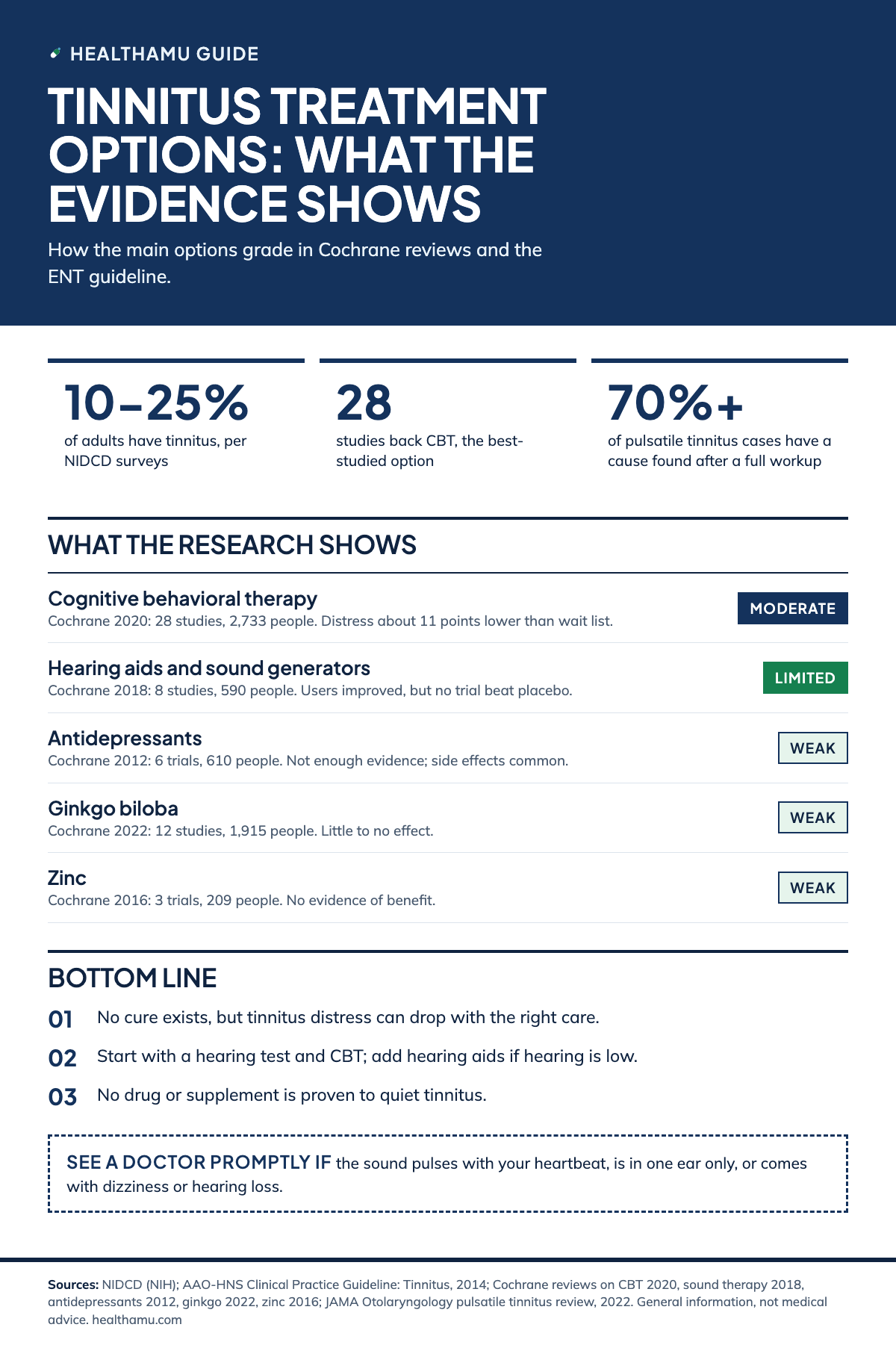
The table below sums up the strongest review for each option. We use four plain grades: Moderate (several pooled trials, small consistent effect), Limited (some trials, small or low quality), Weak (reviews found no clear benefit) and Avoid (no evidence plus a safety problem).
| Option | Review and size | What it found | Grade |
|---|---|---|---|
| CBT | Cochrane 2020, 28 studies, 2,733 people | Distress about 10.91 points lower than wait list; effect beyond 6 months unknown[4] | Moderate |
| Hearing aids and sound generators | Cochrane 2018, 8 studies, 590 people | People improved on both, but no trial showed them beating a wait list or placebo[5] | Limited |
| Antidepressants | Cochrane 2012, 6 trials, 610 people | Not enough evidence that they improve tinnitus; side effects common[8] | Weak |
| Ginkgo biloba | Cochrane 2022, 12 studies, 1,915 people | Little to no effect on distress, very low certainty[7] | Weak |
| Zinc | Cochrane 2016, 3 trials, 209 people | No evidence it improves symptoms[9] | Weak |
What causes tinnitus?
Tinnitus most often goes along with hearing loss or loud noise exposure, and the leading theory is that the brain creates the sound after the inner ear sends it a weaker signal. That is why the noise can seem to come from the ear while the source sits in the hearing part of the brain[1].
NIDCD links tinnitus to these causes[1]:
- Loud noise at work, concerts or from gunfire. It is the most common service-related disability among veterans.
- Hearing loss from aging or noise.
- Medicines, especially at high doses, including aspirin, ibuprofen and naproxen, some antibiotics, cancer drugs, malaria drugs and antidepressants.
- Earwax or fluid from an ear infection.
- Head or neck injuries.
- Less often, Meniere’s disease, jaw joint problems, a benign nerve tumor (acoustic neuroma), blood vessel problems, diabetes, thyroid disease or anemia.
MedlinePlus adds that alcohol, caffeine and smoking may make existing tinnitus worse[2]. Some people develop tinnitus for no known reason[1]. The cause decides the treatment. Earwax removal or a change of medicine can quiet the sound, while noise damage usually calls for longer-term management.
Is there a cure for tinnitus?
No. NIDCD states plainly that there is currently no cure for tinnitus, though there are ways to reduce symptoms. The exception is tinnitus with a clear physical cause, such as earwax or a jaw joint problem, where fixing the cause can remove or greatly reduce the sound[1].
For many people, though, symptoms last months or years[1]. NIDCD calls tinnitus chronic once it lasts 3 months or longer, and notes that it can improve or fade over time in some people while it worsens in others[1]. The guideline separates recent tinnitus from tinnitus lasting 6 months or more, partly so doctors can talk through how it tends to change over time[3].
Be wary of any product sold as a “cure”. A 2019 Stanford review of over-the-counter tinnitus remedies found that all of them made unfounded claims of relief from ear ringing[10]. A realistic goal is a sound you notice less and that bothers you less.
Does cognitive behavioral therapy help tinnitus?
Yes, CBT has the strongest evidence of any tinnitus treatment for reducing how much the sound affects daily life. It works on how you react to the noise, since that reaction often drives the poor sleep, stress and trouble concentrating; the sound itself stays the same[1][4].
The 2020 Cochrane review pooled 28 studies with 2,733 adults who had tinnitus for at least 3 months. Courses ran 3 to 22 weeks, mostly in hospitals or online. Compared with a wait list, CBT lowered scores on the Tinnitus Handicap Inventory by 10.91 points out of 100. A change of about 7 points is the smallest that people notice[4].
Against standard audiology care, CBT scored 5.65 points better, based on 3 studies with 444 people and rated moderate certainty[4]. Serious side effects were rare. The main gap is time: the review found no evidence on whether the benefit lasts to 6 or 12 months[4]. CBT may also slightly ease depression symptoms[4].
A typical program teaches you to spot thoughts that make tinnitus feel threatening, then practice responses that shrink its pull on your attention[1]. Ask your doctor or audiologist for a referral to a psychologist who offers CBT for tinnitus, or for a structured online course.
Do hearing aids and sound therapy help ringing in the ears?
Hearing aids and sound devices can make ringing in the ears less noticeable, especially for people who also have hearing loss, but trials have not shown them beating placebo. The guideline recommends a hearing aid evaluation when tinnitus comes with documented hearing loss and lists sound therapy as an option[3].
NIDCD describes four kinds of sound therapy[1]:
- Tabletop or phone sound generators that play rain, waves or a fan sound, often used at bedtime.
- Hearing aids, which make outside sound louder so the tinnitus stands out less.
- Wearable sound generators that sit in the ear and play soft, steady sound all day.
- Combination devices that amplify and generate sound in one unit.
Trials of these devices are few and small. A 2018 Cochrane review of 8 studies with 590 people found that users of hearing aids and sound generators improved, but no study compared them with a wait list or placebo in a way that showed a clear advantage[5]. A 2014 Cochrane review on hearing aids found only one trial, with 91 people, and it showed no difference between hearing aids and sound generators[6].
Tinnitus retraining therapy pairs counseling with low-level sound to help the brain treat the noise as unimportant[1]. In one small trial in the CBT review, CBT outscored it[4].
Is there a tinnitus medication or supplement that works?
No medicine or supplement has been shown to reliably reduce tinnitus, and the FDA has approved no drug for it. Doctors may still prescribe an antidepressant or anti-anxiety medicine to help with mood or sleep problems that come with tinnitus[1].
The 2012 Cochrane review of antidepressants included 6 trials with 610 people. Trial quality was generally low, and the authors found insufficient evidence that the drugs improve tinnitus. Side effects such as drowsiness, sexual problems and dry mouth were common[8]. That is why the guideline advises against using antidepressants, anticonvulsants or anti-anxiety drugs as routine tinnitus treatment[3].
What about Lipo-Flavonoid and other tinnitus supplements?
Supplements sold for tinnitus have weak support. The guideline recommends against ginkgo, melatonin, zinc and other dietary supplements for persistent tinnitus[3], and NIDCD says none of the vitamins, herbs or supplements advertised as cures has been proven effective[1].
- Ginkgo biloba: 12 studies, 1,915 people. Pooled data from 85 people showed little to no change in distress, with very low certainty[7].
- Zinc: 3 trials, 209 people. In the largest, 5% improved on zinc and 2% on placebo, a difference that was not significant[9].
- Melatonin, alpha-lipoic acid, acai and blends: a 2026 review of 9 trials with 390 adults found results inconsistent and common placebo responses, so no firm conclusions could be drawn[11].
- Lipo-Flavonoid: we found no randomized trial of the product in PubMed. The 2019 Stanford review named it as a brand that markets to ENT doctors and features their supposed endorsement[10].
The same Stanford review found most tinnitus products were mixes of cheap, common vitamins, minerals or herbs sold at a premium[10]. If you still want to try one, tell your doctor first, especially if you take other medicines, are pregnant or have a long-term condition, and set a stop date. MedlinePlus also notes that some medicines and supplements can themselves trigger ear noise[2].
How can you stop tinnitus quickly?
There is no proven way to stop tinnitus immediately, but adding soft background sound and lowering stress can make it fade into the background within minutes. Tinnitus is often loudest at night because the room is quiet, so masking sound helps most at bedtime[1][2].
Steps MedlinePlus and NIDCD describe for quick relief[1][2]:
- Turn on a fan, white noise machine, humidifier or a rain sound on your phone, set just below the level of the tinnitus.
- Step away from loud noise and wear earplugs in loud places to avoid further damage.
- Skip caffeine, alcohol and smoking, which may make tinnitus worse.
- Use a relaxation method. Stress has not been shown to cause tinnitus, but it can make it worse.
- Try sleeping with your head raised, which may make the noise less noticeable.
- If the ringing started after a new medicine, call your doctor. Do not stop a prescribed drug on your own.
Use this decision table to match your situation to a next step[1][2][3][12]:
| If your tinnitus | Then |
|---|---|
| Started after a loud concert and is fading | Rest your ears, use earplugs next time, see a doctor if it lasts more than a few weeks |
| Comes with muffled hearing in one ear | See a doctor to check for earwax or fluid |
| Has lasted 6 months and bothers you | Ask about a hearing test and a CBT referral |
| Comes with hearing loss | Ask for a hearing aid evaluation |
| Pulses with your heartbeat | Book a doctor visit; imaging is often needed |
| Comes with hearing loss in one ear, dizziness or a head injury | Get medical care promptly |
When should you see a doctor about tinnitus?
See a doctor about any new tinnitus that lasts, and go promptly if it pulses with your heartbeat, affects one ear only or comes with dizziness or hearing loss. Most tinnitus is not linked to a serious problem, but these patterns can point to a cause that needs testing[1][2].
Pulsatile tinnitus, a rhythmic whooshing that keeps time with the pulse, is the clearest warning sign. A 2022 review in JAMA Otolaryngology found that a cause can be found in more than 70% of people with pulsatile tinnitus after a thorough workup. Causes include blood vessel problems, raised pressure around the brain and tumors, and the symptom can be a warning of stroke[12]. NIDCD notes that pulsing tinnitus often has an identifiable cause and can be treatable[1].
See a doctor right away if[2][3][12]:
- The noise pulses in time with your heartbeat.
- It started after a head injury.
- It comes with dizziness, poor balance, nausea or vomiting.
- It is in one ear only and lasts several weeks or longer.
- You notice hearing loss in one ear, or new weakness or numbness.
A first visit usually includes questions about noise, medicines and health history, an ear exam and a referral for a hearing test[1][3]. For tinnitus that is in both ears, not pulsing and has no other warning signs, the guideline advises against routine head scans[3].
Practical checklist before your appointment
- Write down when the sound started and whether it is in one ear, both ears or your head.
- Note whether it pulses with your heartbeat.
- List every medicine, vitamin and supplement you take, with doses[2].
- Record recent loud noise, ear infections or head injuries.
- Rate how much it affects your sleep, mood and focus from 0 to 10.
- Ask whether you need a full hearing test and a CBT referral[3].
Read more on tinnitus relief and ringing in the ears as we add new guides.
Which tinnitus treatment should you try first?
For most people with tinnitus that lasts and bothers them, a hearing test plus CBT is the best first step, with hearing aids added when there is hearing loss. That matches the AAO-HNS guideline and the Cochrane evidence[3][4].
If we were choosing, we would pay for a hearing test and a CBT course before any bottle of pills. CBT has 28 studies behind it, while supplements like ginkgo and zinc have reviews showing little or no benefit[4][7][9]. Background sound costs nothing and helps many people sleep. If the noise pulses, sits in one ear or came with dizziness or hearing loss, skip the home steps and see a doctor first[2][12].
Frequently asked questions
What is the best treatment for tinnitus?
Cognitive behavioral therapy has the strongest evidence. A Cochrane review of 28 studies found it lowered tinnitus distress scores by about 11 points out of 100 compared with a wait list. People with hearing loss should also get a hearing aid evaluation.
What is the best tinnitus relief at night?
Soft background sound, such as a fan, white noise machine or rain sounds on a phone, helps most at night because a quiet room makes ringing stand out. Skipping caffeine and alcohol in the evening and using a relaxation routine may also help.
Does Lipo-Flavonoid work for tinnitus?
We found no randomized trial of Lipo-Flavonoid in PubMed. A 2019 Stanford review listed it among tinnitus products marketed with unproven claims, and the ENT guideline recommends against supplements for persistent tinnitus.
Can tinnitus go away on its own?
Yes, in some people. NIDCD says tinnitus may improve or even go away over time, though in others it worsens. Tinnitus lasting 3 months or longer is called chronic.
What is pulsatile tinnitus?
Pulsatile tinnitus is a rhythmic sound that keeps time with your heartbeat. It often has an identifiable cause, such as a blood vessel problem, and can rarely signal stroke risk, so it should always be checked by a doctor.
Sources
- What Is Tinnitus? Causes and Treatment. National Institute on Deafness and Other Communication Disorders (NIH), 2023
- Tinnitus. MedlinePlus Medical Encyclopedia, reviewed 2026
- Clinical practice guideline: tinnitus (Tunkel et al.). American Academy of Otolaryngology-Head and Neck Surgery Foundation, Otolaryngol Head Neck Surg, 2014
- Cognitive behavioural therapy for tinnitus (Fuller et al.). Cochrane Database of Systematic Reviews, 2020
- Sound therapy (using amplification devices and/or sound generators) for tinnitus (Sereda et al.). Cochrane Database of Systematic Reviews, 2018
- Amplification with hearing aids for patients with tinnitus and co-existing hearing loss (Hoare et al.). Cochrane Database of Systematic Reviews, 2014
- Ginkgo biloba for tinnitus (Sereda et al.). Cochrane Database of Systematic Reviews, 2022
- Antidepressants for patients with tinnitus (Baldo et al.). Cochrane Database of Systematic Reviews, 2012
- Zinc supplementation for tinnitus (Person et al.). Cochrane Database of Systematic Reviews, 2016
- Over-the-Counter Tinnitus Cures: Marketers' Promises Do Not Ring True (Vendra et al.). Laryngoscope, Stanford University, 2019
- Over-the-counter treatments for tinnitus: a systematic review of randomized controlled trials. Laryngoscope Investigative Otolaryngology, 2026
- Diagnostic Approach to Pulsatile Tinnitus: A Narrative Review. JAMA Otolaryngology-Head and Neck Surgery, 2022

Lucie Bricks is the Reviews Editor at Healthamu, a buyer's guide for supplements sold through online ads. Lucie reads the full label, sets each dose beside the doses used in human studies, grades the research with sources such as the NIH Office of Dietary Supplements and NCCIH, and works out the real cost per day, refund terms and checkout fine print. Lucie is not a doctor, dietitian, nurse or pharmacist. Reviews give pros, cons and who a product suits, never scores. How we review supplements.
This article is general information, not medical advice. Dietary supplements are not reviewed by the FDA for safety or effectiveness before they are sold. Talk to your doctor before you start any supplement, especially if you are pregnant, nursing, take medication or have a health condition.