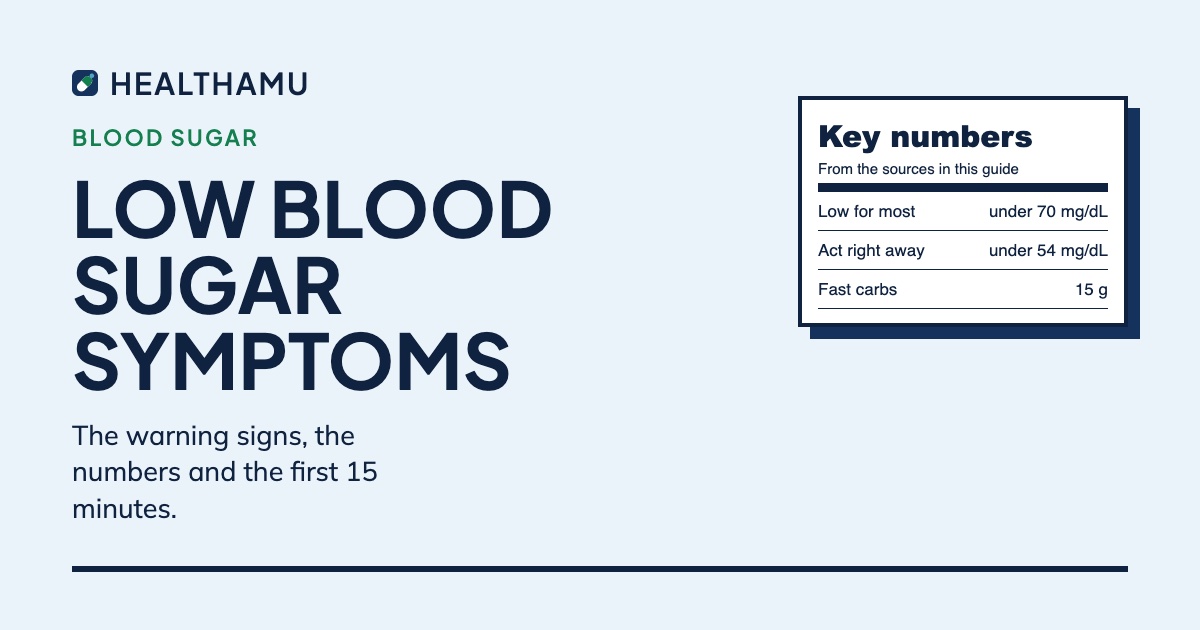
Low blood sugar usually starts with shaking, sweating, sudden hunger, a pounding heart and irritability. For many people with diabetes this begins below 70 mg/dL, and readings under 54 mg/dL need action right away. The standard fix is 15 grams of fast carbohydrate, such as 4 glucose tablets, then a recheck after 15 minutes. Call 911 if someone passes out.
On this page
- What does low blood sugar feel like?
- Which glucose readings count as hypoglycemia?
- Which low blood sugar symptoms show up at night or go unnoticed?
- What causes hypoglycemia, and who is most at risk?
- Do low blood sugar symptoms differ in women?
- How do you treat low blood sugar in the first 15 minutes?
- When is low blood sugar an emergency?
- How do doctors diagnose hypoglycemia and lower the risk?
- Bottom line
- FAQ
To map low blood sugar symptoms and the point where they turn dangerous, we read the NIDDK guide to low blood glucose, four MedlinePlus pages, the American Diabetes Association’s 2026 Standards of Care, two Endocrine Society guidelines and a 2026 meta-analysis on sex differences. The steps we follow are on our how we review health topics page.
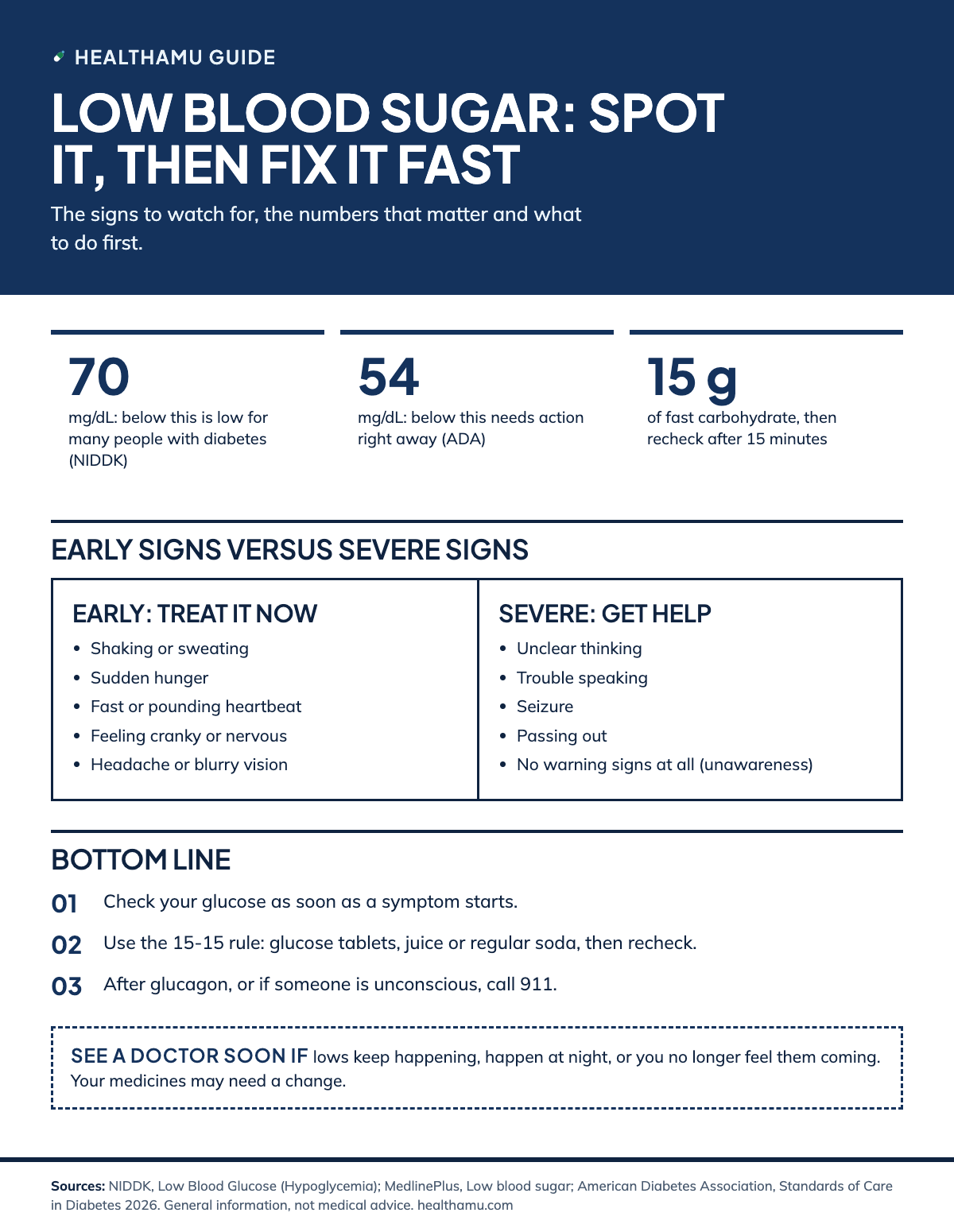
Shaking, sweating, hunger, a fast heartbeat and irritability are the usual first signs, and for many people with diabetes they appear once a reading drops below 70 mg/dL [1].
| What it is | Blood glucose too low to fuel the body and brain; for many people with diabetes, a reading under 70 mg/dL (3.9 mmol/L) [1][2] |
|---|---|
| Without diabetes | Usually a reading under 55 mg/dL, and uncommon [3] |
| Early signs | Shaky, sweaty, hungry, dizzy, cranky, pounding heartbeat, headache [1][2] |
| Serious signs | Unclear thinking, seizure, passing out; more likely under 54 mg/dL (3.0 mmol/L) [2] |
| Most common cause | Insulin or pills that make the pancreas release more insulin [1][7] |
| First step | 15 grams of fast-acting carbohydrate, then recheck after 15 minutes [4][5] |
| Call 911 | The person is unconscious and no glucagon is on hand, or cannot be woken [2][5] |
What does low blood sugar feel like?
Low blood sugar usually feels like a sudden wave of shakiness, sweat and hunger, often with a pounding heart and a short temper. NIDDK notes that symptoms tend to come on quickly and range from mild to severe [1]. Many people with diabetes feel nearly the same set of signs every time they go low [2].
MedlinePlus lists the signs people report most often [2]:
- Shaking or trembling, and sweating [2]
- Hunger that arrives out of nowhere [1][2]
- Feeling nervous, cranky or even aggressive [2]
- A fast or pounding heartbeat [1][2]
- Tingling or numbness of the skin [2]
- Tiredness, weakness or dizziness [1][2]
- Headache, blurry or double vision [2]
Hunger and sweat tend to show up when glucose is only a little low. Unclear thinking and seizures are more likely once it falls under 54 mg/dL [2]. At that stage the brain is short of fuel, and a person may not be able to speak clearly or may lose consciousness [1].
Because confusion is part of the picture, the person having the low is not always the best judge of it. NIDDK advises checking your glucose as soon as you notice a symptom, so the number decides what happens next [1].
Which glucose readings count as hypoglycemia?
Hypoglycemia is the medical name for low blood glucose, and for most people with diabetes it starts at a reading under 70 mg/dL. The ADA splits it into three levels so that patients and doctors use the same words [6]. People without diabetes use a lower cutoff, usually under 55 mg/dL [3].
| Level | Reading | What it means |
|---|---|---|
| Level 1 | Under 70 and at or above 54 mg/dL | Low; treat with fast carbohydrate [6] |
| Level 2 | Under 54 mg/dL (3.0 mmol/L) | Needs immediate action [4][6] |
| Level 3 | Any number | A severe event where someone else must help [6] |
Level 3 is about what happens to the person. If you need another person to treat you, it counts as severe whatever the reading [6].
For people who wear a continuous glucose monitor, the ADA sets a goal of spending less than 4% of the day under 70 mg/dL for most adults [6]. Your care team can use that figure to spot a pattern of lows early.
Which low blood sugar symptoms show up at night or go unnoticed?
Lows during sleep often show up as nightmares, crying out, or sheets damp with sweat, and some people feel no warning signs at all. NIDDK says glucose can fall while you sleep and stay low for several hours [1]. Waking up tired or confused can be the only clue the next morning [1].
The second hidden form is called hypoglycemia unawareness. It means the early alarm signals fade, so a person does not notice anything until glucose is already very low [1]. MedlinePlus warns that some people find out only when they faint, have a seizure or go into a coma [2].
Two things make missed lows more likely. Repeated lows can blunt the warning signs over time [1]. Alcohol can also hide the first symptoms, which is risky if you drink without eating [1].
Some CGMs sound an alert for you and for people you choose when glucose drops below a set level [2]. If you have woken up drenched or foggy more than once, write the dates down and bring them to your next visit.
What causes hypoglycemia, and who is most at risk?
The most common cause of hypoglycemia is diabetes treatment itself: insulin, or pills that push the pancreas to release insulin. The Endocrine Society named these drugs as the leading cause in its 2009 guideline [7], and its 2023 guideline again points to insulin and sulfonylureas as the higher-risk medicines [8].
In daily life, a low usually comes from a mismatch between medicine, food and activity. MedlinePlus lists the usual triggers [4]:
- Taking insulin or a diabetes pill at the wrong time, or taking too much [4]
- Skipping or delaying a meal [4]
- More exercise than usual; NIDDK says extra activity can lower glucose for up to 24 hours afterward [1][4]
- Drinking alcohol, especially without food [1][4]
NIDDK says you are more likely to go low if you have type 1 diabetes, take insulin or certain other diabetes medicines, are 65 or older, have had lows before, or live with kidney disease, heart disease or cognitive impairment [1].
Low blood sugar without diabetes
Outside of diabetes, true hypoglycemia is rare [3]. Causes MedlinePlus lists include heavy drinking, a lack of cortisol, growth hormone or thyroid hormone, organ failure, severe infection, and weight loss surgery, usually 5 or more years later [2]. Some heart medicines and antibiotics can play a role too [3].
A very rare cause is an insulinoma, a tumor in the pancreas that keeps making insulin when the body does not need it [10]. Most are not cancer, and symptoms tend to appear when a person is fasting or skips a meal [10].
How common are lows? What the research shows
| Study | Who and how many | Main finding |
|---|---|---|
| HAT study, cited by NIDDK | 27,585 people on insulin in 24 countries [9] | 4 in 5 with type 1 and nearly half with type 2 reported a low over 4 weeks [1] |
| Comparison of 24 real-world studies, 2019 | More than 24,000 with type 1 and 160,000 with type 2 [9] | 21.8 to 73.3 events per person per year in type 1; 1.3 to 37.7 in type 2 [9] |
| Same 2019 review, severe lows | Same groups [9] | 0.7 to 5.8 severe events a year in type 1; 0 to 2.5 in type 2 [9] |
| NIDDK estimate for U.S. adults | Adults on insulin or insulin-releasing pills [1] | About 2 in 100 have a severe low each year [1] |
Two of the 2019 review’s authors worked for Novo Nordisk, an insulin maker, so read the figures as a range rather than a precise rate [9]. Even so, the review concluded that lows are common in people who use insulin.
Do low blood sugar symptoms differ in women?
The research does not show that women get a different set of warning signs; the core symptoms are the same. A 2026 meta-analysis of 24 studies in adults on insulin found no clear difference between women and men in outpatient lows (risk ratio 1.08, range 0.61 to 1.89) [12]. The authors rated the evidence low certainty and called their findings hypothesis-generating [12].
A few situations apply only to women:
- After giving birth, glucose in women with diabetes can drop very quickly, so NIDDK advises frequent checks in the first few days [11].
- Breastfeeding raises the risk of low glucose at night [11].
- MedlinePlus advises women with diabetes to limit alcohol to 1 drink a day, compared with 2 for men [4].
If your symptoms seem to shift with your cycle or with menopause, tell your care team. We found no strong source on those links, so we leave them out here rather than guess.
How do you treat low blood sugar in the first 15 minutes?
The 15-15 rule is the standard first fix: take 15 grams of fast-acting carbohydrate, wait 15 minutes, then check again. The ADA and MedlinePlus both teach it [4][5], and NIDDK gives a range of 15 to 20 grams [1]. Pure glucose is the preferred choice, and foods high in fat or protein should not be the first thing you reach for [6].
- Check your glucose as soon as a symptom appears [1].
- If the reading is under 70 mg/dL or below your target, take 15 to 20 grams of fast carbohydrate [1].
- Sit down and wait 15 minutes [1][4].
- Check again. If you are still low, repeat the dose [1][6].
- Once you are back in range, eat a snack if your next meal is more than 1 hour away [1].
- Write down the time, the reading and what you think caused it, for your next visit.
| Option | Amount | Note |
|---|---|---|
| Glucose tablets | 4 tablets [1] | Best choice if you take medicine that slows digestion [1] |
| Fruit juice | 1/2 cup (4 ounces) [1] | Skip orange juice if you have kidney disease [1] |
| Regular soda | 1/2 can (4 to 6 ounces) [1] | Not diet or reduced-sugar [1] |
| Sugar or honey | 1 tablespoon [1] | Corn syrup works too [1] |
Decision table: what to do based on what you see
| If | Then |
|---|---|
| You feel shaky or hungry and read 54 to 69 mg/dL | Use the 15-15 rule and recheck [4][6] |
| You read under 54 mg/dL | Treat right away; this is level 2 [4][6] |
| Symptoms do not improve after a sugary snack | Get a ride to the emergency room or call 911 [2] |
| The person cannot treat themselves | Someone gives glucagon, then calls 911 [1] |
| The person is unconscious and there is no glucagon | Call 911 at once [5] |
When is low blood sugar an emergency?
A low becomes an emergency when the person can no longer treat it alone, because they are too confused to act, are having a seizure, or have passed out. Glucagon, given as a shot or a nasal spray, is the best way to treat a severe low, and NIDDK tells helpers to call 911 right after using it [1].
See a doctor right away, or call 911, if:
- The person is less alert or cannot be woken [2]
- Someone is unconscious and no glucagon is available [5]
- Glucagon was just given [1]
- A seizure happens [1]
- Symptoms do not improve after a sugary snack; get a ride to the emergency room, and do not drive yourself [2]
Check the expiry date on any glucagon kit, and teach family, friends and coworkers when and how to use it [1].
Severe lows can also cause brain damage, and even one severe episode can make the next one harder to recognize [2]. A medical alert bracelet or pendant tells strangers you have diabetes and need care right away [1][4]. If you take insulin, the ADA recommends that a glucagon prescription be part of your plan [6].
How do doctors diagnose hypoglycemia and lower the risk?
Doctors confirm hypoglycemia with three findings, known as Whipple’s triad: symptoms, a measured low glucose, and relief once glucose is raised. The Endocrine Society uses this test so that symptoms alone do not lead to the label [7]. In people without diabetes, the next step is finding the cause [7].
That search can mean blood tests for glucose, insulin and C-peptide after fasting, plus imaging of the pancreas if an insulinoma is suspected [10]. Some people wear a small monitor that measures glucose every 5 minutes for 3 to 14 days [2].
For people with diabetes, care centers on the treatment plan. The 2023 Endocrine Society guideline made 10 recommendations [8]. Its strong ones include structured diabetes education for people at high risk, ready-to-use glucagon instead of kits that must be mixed, and real-time CGM for people with type 1 diabetes on multiple daily injections [8]. The ADA also recommends CGM for people at high risk of lows [6].
No supplement replaces fast glucose during a low or a medicine review from your doctor. If lows keep happening, the usual fix is adjusting the dose or timing of insulin or pills with your care team [1][4]. You can read more in our blood sugar guides.
A short checklist to cut the risk of lows
- Carry glucose tablets or gel everywhere, including the car and gym bag [1].
- Plan for lows for up to 24 hours after a workout that is harder than usual [1].
- Eat when you drink alcohol, and keep to 1 drink a day for women or 2 for men [1][4].
- Do not skip meals on days you take insulin or a sulfonylurea [4][8].
- Ask whether a CGM with alerts makes sense for you [2][6].
- Keep a glucagon kit that is in date, and show someone how to use it [1].
- Wear a medical alert ID [1][4].
- Read the label on any new medicine or supplement, and ask your pharmacist whether it affects blood sugar.
Bottom line
Low blood sugar announces itself with shaking, sweat, hunger and a racing heart, and it can move to confusion or passing out if it is not treated. For most people with diabetes the line is 70 mg/dL, and under 54 mg/dL calls for action right away [1][6].
For most readers, the most useful step is to keep 15 grams of glucose within reach and know the 15-15 rule by heart, because treating a low at the first sign is the step every source we read agrees on. If lows happen more than now and then, or you have stopped feeling them coming, that is a reason to see your doctor soon about your medicines and a CGM [1][8].
Frequently asked questions
What is low blood sugar?
Low blood sugar, or hypoglycemia, means your blood glucose has dropped below what your body and brain need. For many people with diabetes that is a reading under 70 mg/dL. Without diabetes, doctors usually use a cutoff under 55 mg/dL.
What are the symptoms of low blood sugar in women?
Women report the same core signs as men: shaking, sweating, hunger, a fast heartbeat and irritability. A 2026 meta-analysis found no clear sex difference in lows. Lows can come on fast after childbirth, and breastfeeding raises the risk at night.
Can low blood sugar happen if you do not have diabetes?
Yes, but it is rare. Causes include heavy drinking, hormone problems, liver or kidney disease, severe infection, some medicines, weight loss surgery and, very rarely, an insulin-making tumor called an insulinoma. A doctor should look for the cause.
What is the fastest way to raise blood sugar?
Glucose tablets or gel work fastest, followed by regular juice or soda. Take 15 to 20 grams, wait 15 minutes and recheck. Diabetes guidelines advise against high-fat or high-protein foods as the first treatment.
Is a blood sugar of 60 dangerous?
A reading of 60 mg/dL is level 1 hypoglycemia. It is not an emergency yet, but you should treat it right away with fast carbohydrate and recheck in 15 minutes. Readings under 54 mg/dL are level 2 and need immediate action.
Sources
- Low Blood Glucose (Hypoglycemia). NIDDK, National Institutes of Health
- Low blood sugar. MedlinePlus Medical Encyclopedia, reviewed 2026
- Hypoglycemia. MedlinePlus, National Library of Medicine
- Low blood sugar: self-care. MedlinePlus, National Library of Medicine
- Low Blood Glucose (Hypoglycemia). American Diabetes Association
- 6. Glycemic Goals, Hypoglycemia, and Hyperglycemic Crises: Standards of Care in Diabetes 2026. American Diabetes Association, Diabetes Care, 2026
- Evaluation and management of adult hypoglycemic disorders: an Endocrine Society clinical practice guideline. J Clin Endocrinol Metab, 2009
- Management of Individuals With Diabetes at High Risk for Hypoglycemia: An Endocrine Society Clinical Practice Guideline. J Clin Endocrinol Metab, 2023
- Comparison of the HAT study, the largest global hypoglycaemia study to date, with similar large real-world studies. Diabetes Obes Metab, 2019
- Insulinoma. MedlinePlus Medical Encyclopedia
- Pregnancy if You Have Diabetes. NIDDK, National Institutes of Health
- Sex differences in glycemic outcomes: systematic review and meta-analysis. BMJ Open Diabetes Res Care, 2026

Lucie Bricks is the Reviews Editor at Healthamu, a buyer's guide for supplements sold through online ads. Lucie reads the full label, sets each dose beside the doses used in human studies, grades the research with sources such as the NIH Office of Dietary Supplements and NCCIH, and works out the real cost per day, refund terms and checkout fine print. Lucie is not a doctor, dietitian, nurse or pharmacist. Reviews give pros, cons and who a product suits, never scores. How we review supplements.
This article is general information, not medical advice. Dietary supplements are not reviewed by the FDA for safety or effectiveness before they are sold. Talk to your doctor before you start any supplement, especially if you are pregnant, nursing, take medication or have a health condition.